

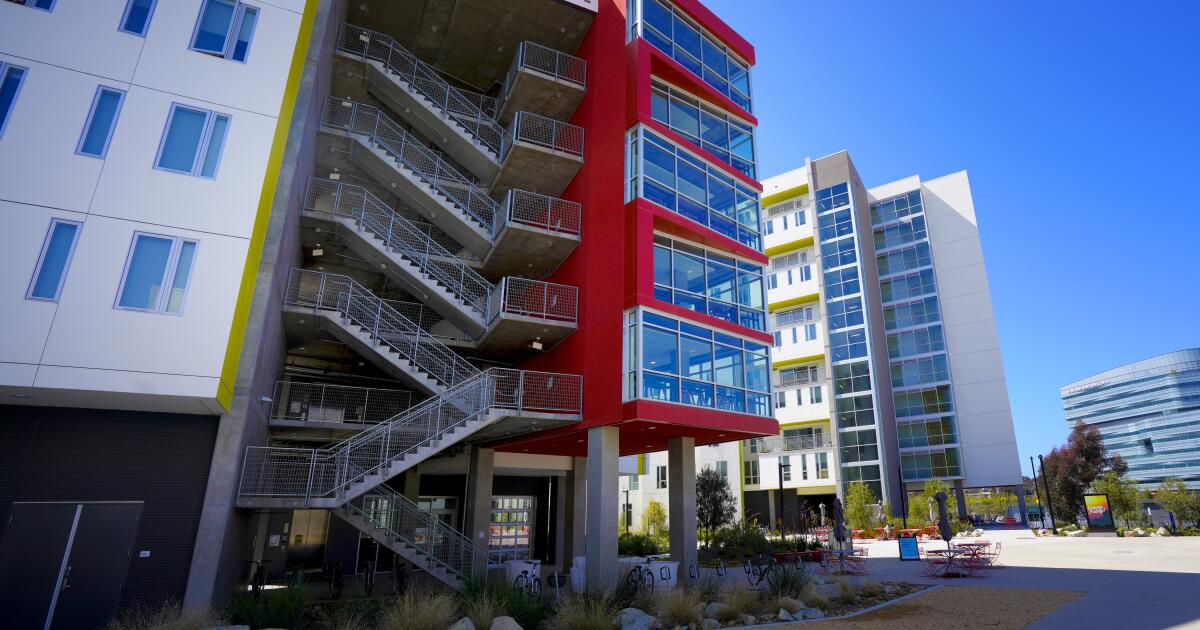
Waters is majoring in business administration at UC Irvine and lives in Irvine.
In fall 2021, more than 7,500 University of California students were on wait lists for on-campus housing. UC Santa Barbara, UC San Diego and UC Merced put students in hotels due to a shortage of space, and other UC Santa Barbara students were forced to live in vans on the street.
The housing crisis continued for the world’s leading public university system in 2022, when almost 4,000 surveyed undergraduate students (8 percent of respondents) at UC campuses reported that they had no reliable place to sleep at night. People of color, the LGBTQ+ community and international students were much more likely to indicate that they lacked dependable housing.
In 2022, UC Santa Cruz admitted around 800 fewer students than intended solely due to housing shortages. Admission to a UC campus is a life-changing opportunity. Denying that to deserving students or putting them into a situation where they are inherently disadvantaged and may experience homelessness is deeply unfair.
The UC housing crisis and its disproportionate impact on marginalized communities showcase the UC’s failure to achieve its stated mission to encourage diversity and give all students an equal chance at success. UC schools are great creators of economic mobility for everyone, specifically the low-income students they often admit. The UC housing crisis makes it more challenging for students from marginalized groups to improve their economic prospects, enabling race-based generational wealth gaps to persist.
The UC system’s housing crisis and its detrimental effects are partly due to the meteoric rise in undergraduate applicants and admittances since 2021. This school year, the housing crises that have already boiled over at some UC universities seem destined to worsen with a continued large influx of new students.
The solution is more complicated than simply creating more housing because of various legal considerations. Local groups in UC campus communities have also contributed to the UC housing crisis by using the California Environmental Quality Act to delay and cancel housing projects.
In 2021, the La Jolla Shores Association filed a lawsuit against a UC San Diego housing plan that would shelter about 2,000 students, citing traffic and loss of wildlife as key concerns. In 2022, Santa Cruz residents blocked a proposal to create around 3,000 beds at UC Santa Cruz because they believed the area’s landscape would lose its aesthetic appeal.
For unhoused college students, the stakes are much more dire than environmental considerations and quality-of-life worries like traffic and noise levels. Having a home can be the difference between life and death, making it crucial to prioritize the creation of student housing.
UCLA has proven that it’s possible to avoid a housing crisis. In March 2022, UCLA became the only UC school to offer four years of guaranteed on-campus residence to incoming undergraduate students. All UC institutions should reach this standard, and it’s disappointing that only UCLA has attained it so far.
UCLA achieved that benchmark because it built more student housing ahead of time. UCLA’s Olympic and Centennial halls began accommodating students in fall 2021 after construction began in 2019. Other UC schools have failed to make similar investments, and students have been suffering for it. Every undergraduate UC campus aims to increase the number of available beds in the next several years, but it’s clear that these initiatives weren’t enacted early enough.
UCs that have faced legal roadblocks in establishing new housing should not be completely absolved of the blame for their housing crises. They should have introduced housing proposals as early as possible, before more housing was needed, in anticipation of such obstacles.
The UC system’s housing crisis and students’ welfare would be helped with the adoption of hybrid instruction for applicable classes, which enables students to attend classes both in-person and virtually. If all students were empowered to earn their degree through their preferred mode of learning, some students would elect to complete their schooling online. This would leave UC campuses and their surrounding housing markets less overcrowded, making housing easier to obtain for those on campus. The only investment required from UC schools would be providing technology to classrooms and students to ensure universal access to online learning.
If UC schools don’t take strong action to remedy their housing crises, students will continue to be deprived of the opportunity to receive a first-rate education in an equitable learning environment. It is also essential that residents in UC communities stop obstructing housing developments. They must be willing to let UC institutions supply housing for students who desperately need it.
Credit to the Original Article | Explore More of Their Work If You Found This Article Enjoyable.
https://news.google.com/rss/articles/CBMijAFodHRwczovL3d3dy5zYW5kaWVnb3VuaW9udHJpYnVuZS5jb20vb3Bpbmlvbi9jb21tZW50YXJ5L3N0b3J5LzIwMjMtMTEtMjkvb3Bpbmlvbi11Yy1zeXN0ZW0tc3R1ZGVudC1ob3VzaW5nLXNob3J0YWdlLXNhbi1kaWVnby1lcXVpdHktY29sbGVnZdIBAA?oc=5&hl=en-US&gl=US&ceid=US:en