
From the Archive | Building piles and piles of words is not enough. Good writing has a raw, disobedient quality, a feral disposition. So how do we achieve that?

Writing is wild. People have come up with many brilliant ways to do it—many different brilliant ways.
Maybe that’s why some people think writing can’t be taught. But I think it absolutely can—it’s just that not all teachers are good fits for all learners.
That said, writing can be hard to teach, because writing is an art, and it’s personal. Plus, it’s a little weird, the whole idea of making totally alive things out of nothing but words. How unlikely! Yet, language itself is unlikely, too.
So is life.
And everything changes all the time, including my ideas about writing, which are constantly shaped and reshaped just through me being alive, the same way the beach is shaped and reshaped by life of the ocean tides, their rise and fall, and by the ceaseless coastal winds and storms.
So, in that spirit, I share these ideas even in the sure knowledge they will continue shifting and evolving.
Good writing starts with reading. We grow by reading greedily and discerningly and well beyond our preferred genres and tastes. It’s wonderful to expose ourselves to so many different styles of writing and to stay open.
We need to read poetry, too.
Prose writers, especially, have so much to learn from poets.
Poetry gives us a heightened, precise experience of language through concrete specific images, through the pleasure of rhythm, and through the surprise of silence. Poetry teaches us how to point and how to listen, and shows us how to do more with less and how to say something profound without saying it at all. Poetry also brings us back to the question of who we are and why we are here but only by first bring our full attention to the delicacy of the skin over a girl’s wrist.
So yes, we must read truly, madly, deeply, but also, we must take great pains to decode the works we read so that we can figure out exactly what those writers did to make certain passages and whole books so arresting. This kind of reading, this close reading for the craft of it, is what will change us into the writers we hope to become.
Of course, we must write, too, as much as we can, day after day, showing up for the arduous work putting one word after the next, again and again and again.
But there is more to it than that, because building piles and piles of words is not enough. Building piles of words can even teach us bad habits, get us into the practice of writing lazy sentences, sentences that will never sing. So we must
also write the hard way. Because while writing for pleasure and catharsis and the satisfaction of a growing word count is well and good at times, we must mostly write for the strain and difficulty and torment of it, for the relentless demands of carving meaning from a flabby, overused language that has become, in the digital age, mostly used for “content.”
Writing can feel a little like a wrestling match—an exhilarating effort that leaves us spent and bruised.
This effort is how we reclaim the language, and also how we transform and progress as writers, artists, human beings. This effort is where we meet ourselves anew (and isn’t that the reason for it all?) through grasping at first desperately, and then exactingly, after the perfect verb, through the slashing of pages and pages of “process writing” that are important to wade through as part of the hunt for the actual story, but that do not belong to the actual story, and therefore also do not belong in the actual story. This sweaty effort is our chance for a wide-open and unflinching observation of our limitations on the page, and our chance to get back up, go back in there, and try harder.
This effort is where the art happens—and it’s the art that matters.
Speaking of art, as writers we need to notice our surroundings with a sense of interest, wonder, and awe. We need to cultivate a searing curiosity about everything and everyone, because curiosity is the genesis of empathy. Our job as writers is to ask why, why, why, why, and be doggedly interested in the multiplicity of possibilities rather than relying too surely on what we think we know.
And we need to leave room for play, and for joy, and for the great fun and pleasure of creating.
Because if we forget this pleasure, we will lose our taste for the work. We will lose our desire. This kaleidoscope of play, joy, fun, and pleasure, all driven by desire, can lead us to our very best writing, if we are brave enough to let it. For it does take courage to allow ourselves to play with our whole selves, like children.
We need to build great tolerance for uncertainty.
This requires a willingness to fail, make messes, write badly in a new way over writing the same thing we already know how to write. We need to learn to love uncertainty, and to consistently choose it over the temptation of knowing.
We need to sit quietly in the dark, even if it hurts.
And by all means we can’t obsess constantly on publication or the workings of the industry. If we want to publish, we should worry about that when the time comes. And the time comes when we’re pretty damn sure (which is as sure as we ever will be) that we’ve written something that’s ready—that’s good enough—for publication. In the meantime, it’s probably better to spend our time writing and improving the writing rather than scheming on the best strategy for breaking in.
Perfecting the writing is an alchemical process that requires an openness to perpetual discovery and refinement. Good writing has a raw, disobedient quality, a feral disposition. That’s what allows it to leap off the page. But achieving prose with that kind of unruly abandon almost always requires an untold amount of grunt work. Good writing that breathes and even gasps on the page almost never comes from focusing on market trends, though many commercially successful books do result from doing exactly that. But a commercially successful book and a transcendent piece of writing are not one and the same. The latter may certainly become the former and it sometimes does, but more often, it does not.
The frequent disconnect between powerful art and commercial remuneration must be understood and accepted from the outset.
Ultimately, we gain the most from focusing on our writing as a practice no different from meditation—we show up, we struggle, we break through or we don’t, and then we do it again.
Only over the course of months, years, decades, a lifetime, if ever, do we begin to see clearly the pattern of our own intricate unfolding within the context of not just our own life, but of everything.
Which is, of course, the point.
Love,
Jeannine
UPCOMING EVENTS FOR WITD FOUNDING MEMBERS*
(all times in Central)
January 27, 1-2PM CT Silent Write-In on Zoom
February 24 1-2PM CT Silent Write-In on Zoom
March 31 1-2PM Silent Write-In on Zoom
April 3 2-3PM Open Mic Salon Reading on Zoom to Celebrate Delights Intensive
(*Manage your subscription level anytime here.)
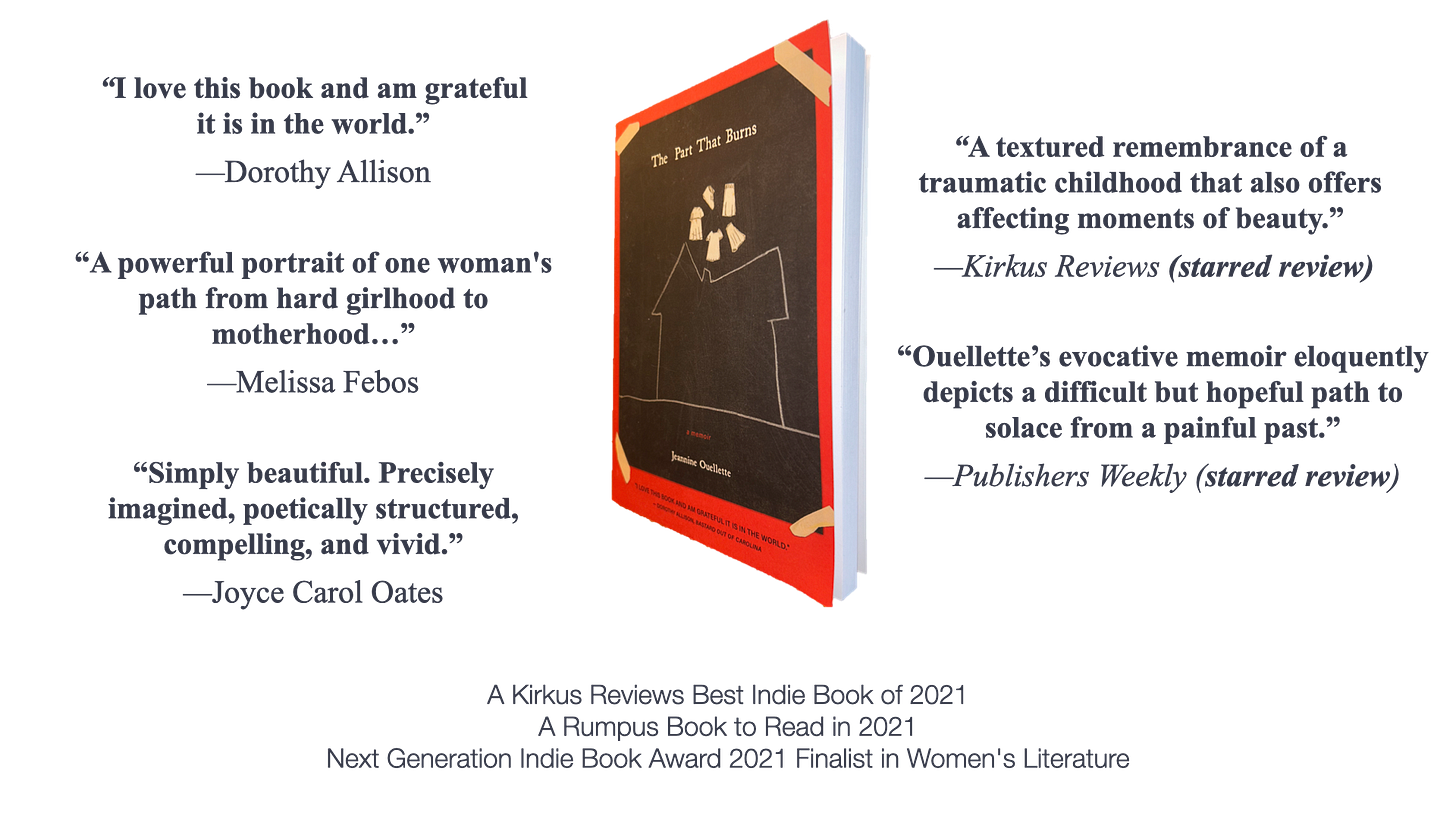
If you or someone you know is walking the long path back to yourself after a painful childhood, then my memoir, The Part That Burns, might help light your way.
Credit to the Original Article | Explore More of Their Work If You Found This Article Enjoyable.
https://writinginthedark.substack.com/p/how-to-be-a-writer-141