


“Every professor I know wasted countless hours of 2024 in the prevention or detection of AI-powered cheating. It is a miserable war of attrition that seems doomed to defeat. Perhaps the time has come, then, to declare a strategic withdrawal from writing as pedagogy?”
That’s Regina Rini (York) in the Times Literary Supplement.
She observes that “the problem is double-barrelled; writing has simultaneously become less valuable and much harder to teach.”
On the first point, about the perceived value of writing:
few students will need to compose essays after leaving school. Think of the adults you know [besides your fellow humanities academics]… When was the last time they needed to write an argument longer than a social media reply? Probably not more recently than the last time they did long division by hand.
Now try to persuade the arriving generation of college students—nearly 90 per cent of whom admit to using ChatGPT for “help” with high-school homework, according to a recent survey in the US—that writing is a skill they must internalize for future success. Brace for eyeroll impact. An ever-increasing share of adults will regard AI writing tools as just more productivity apps on their phone, no more sensible to abjure than calculators.
And on the difficulty of teaching writing:
As for the other side—the terrible cost for educators struggling to hold the line against AI cheating—at stake is the personal indignity of seeing one’s time treated as worthless…. Reading with the care of a surgeon, trying to get inside a student’s head and guess why they used that inappropriate word or missed this obvious argumentative strategy, calibrating advice for varietals of arrogance and fragility—none of this is easy or quick. And all is wasted on a student who cheats by submitting work they did not compose. A pedagogical future of thousands of hours analysing the semantic output of uneducable robots sounds like a particularly sadistic existentialist hell.
What to do? Are you still teaching writing? How are you doing it? For which kinds of classes? If not, what are you doing instead?
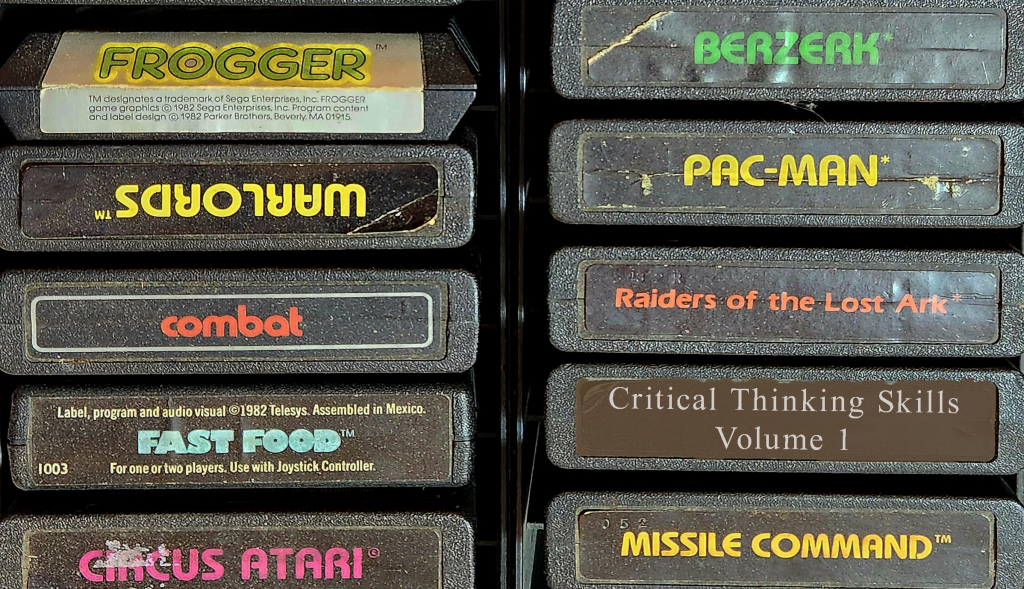
Does this seem like a big loss because it really is one, or because we (I?) lack the foresight or imagination to see the overwhelming benefits?
We discussed this about a year ago. I suspect that parts of that previous conversation will strike us now as naive, and that many teachers over the past year have had their eyes opened to the problems (opportunities?[grimace]) ChatGPT / large language models (LLMs) / AI brings to the teaching of writing.
Of course, the problem is not just with writing, is it? It’s with reading, too. And with the thinking skills that develop during the difficult parts of writing and reading.
That’s the pessimistic view.
But… perhaps this is just a rough patch on our way to Matrix-level technology in which we can simply upload into our minds those (AI-powered?) thinking skills without any of that pesky work.
Of course, there’s the matter of whether anyone then would see the value of uploading such skills as one scrolls through the various options. I suppose that’s the really pessimistic view.
UPDATE: A recently published study on the impact of AI tool use on critical thinking has found that “higher usage of AI tools is associated with reduced critical thinking skills, and cognitive offloading plays a significant role in this relationship.” “Cognitive offloading” is “the delegation of cognitive tasks to external tools, thereby reducing the cognitive load on individuals.”
In “AI Tools in Society: Impacts on Cognitive Offloading and the Future of Critical Thinking” published in Societies, Michael Gerlich (SBS-Swiss Business School / London School of Economics) writes:
The findings revealed a significant negative correlation between frequent AI tool usage and critical thinking abilities, mediated by increased cognitive offloading. Younger participants exhibited higher dependence on AI tools and lower critical thinking scores compared to older participants. Furthermore, higher educational attainment was associated with better critical thinking skills, regardless of AI usage. These results highlight the potential cognitive costs of AI tool reliance, emphasising the need for educational strategies that promote critical engagement with AI technologies… The findings underscore the importance of fostering critical thinking in an AI-driven world.
You can look over the study, published open-access, here.
Credit to the Original Article | Explore More of Their Work If You Found This Article Enjoyable.
https://dailynous.com/2025/01/09/teaching-writing-in-the-ai-era/


 " title="