
Have you been working on your memoir only to find you’ve lost your way? I see this frequently with my memoir writing students in Transylvania County. Some have worked long and hard getting their story down before realizing they don’t know where they’re going.
What’s happened to these writers is not unlike what happened to the stone worker my husband and I hired a few years ago to build a wall around our garden. One day, without consulting us, our master stone layer got carried away and built a path, but his path went nowhere. It just lay there behind the garden wall, all by itself, looking beautiful.
Memoir writers, do not build a path to nowhere! This is exactly what you will do unless you create a road map of where you’re going, or at least, where you think you want to go.
After all, writing a memoir is a journey of self-discovery so while you’ll want to be open to taking detours and even changing directions, a road map will help you stay on track. As you navigate the bumps, U-turns, dead ends, and crossroads awaiting you, you’ll be grateful for a road map because it will stop you from speeding down the road to nowhere.
HOW TO CREATE A ROAD MAP FOR YOUR MEMOIR
•Summarize Your Story:
Summarizing your story before writing it is akin to starting your car’s engine before taking off across the country. Begin by writing a one paragraph story summary. Once you’ve done that, take it to the next level and write a one-page summary. Make the course corrections. Now, you’ve got a thumbnail sketch of the story in front of you on one page. This makes it easy to visualize. Next, make a list of potential story chapters. Don’t worry about the order yet – that can come after you’ve written them when you’re deciding how to structure your story.
•Figure Out Your Theme:
The glue that holds a story together is its theme or the overarching idea, such as love, loss, redemption, quest, courage, perseverance, and survival. One way to figure out your theme is to write what is called the “Six-Word Memoir.” Many of my students have worked on their Six-Word Memoirs. Teresa Adkins wrote “Learning to Love, Falling for Myself,” a story centered around leaving an abusive husband. Dr. Barbra McCune, who served as a medical missionary in Honduras and married while there, penned: “Left the Church, Married a Priest.” Even Ernest Hemingway wrote a Six-Word Memoir: “For Sale: Baby Shoes, Never Worn.”
•Nail Down Your Narrative Arc:
Most memoirs have a clear beginning, middle and end, or a Narrative Arc. The narrative arc has five major parts. They are: (1) Exposition (setting the stage for the story’s conflict) (2) Rising Action (the complication or problem) (3) Climax (the turning point) (4) Falling Action (moving story to its conclusion), and (5) Resolution (bringing story to an end). If you think about the literary memoirs you’ve read, you’ll realize they have a defined narrative arc. Even fairy tales such as Cinderella follow a narrative arc.
•Consider the Story’s Structure:
You can decide how you will structure your story anytime, even after you’ve written most of it. You can tell it chronologically, from beginning to end. Or semi-chronologically as Vivian Gornick does in her memoir, “Fierce Attachments.” Gornick jumps back and forth in time between the present and the past, talking with her mother as they walk around New York. Or, you can structure your story episodically with three to five parts, like Elizabeth Gilbert does in “Eat, Pray, Love.” If you’re writing essays, you could link them together by a theme (family, trips, childhood, coming of age, etc.). Maggie O’Farrell did this in her memoir “I Am, I Am, I Am: Seventeen Brushes with Death.”
Now that you’ve created a road map of your memoir, you are ready to begin one of the most important journeys in your life. Don’t hurry, gift yourself the time and the grace to make meaningful course corrections as you navigate the wide, open road ahead of you. And whatever you do, don’t speed down a highway to nowhere. Take the scenic route and enjoy the riveting and rewarding ride you are about to embark on!
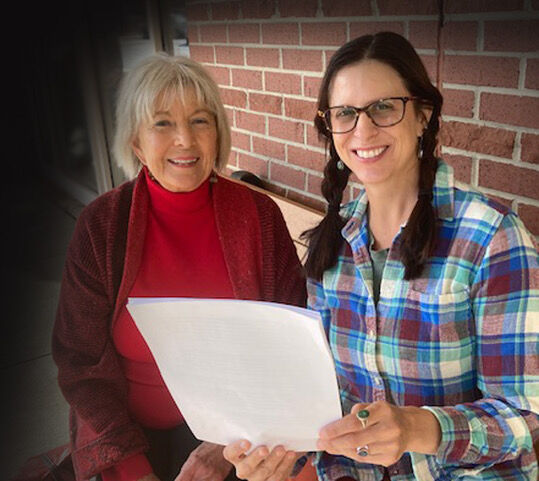
Daphne Larkin is an award-winning book author, columnist and magazine writer who teaches memoir writing at the Transylvania County Library and the Blue Ridge Community College. Her current students will be reading their work at a “Memoir Evening at the Library” on Dec. 4 from 6 p.m. to 7 p.m. Larkin’s next class will be at the library in 2024 from March 25 to May 13. The class will meet on Monday from 3 p.m. to 5 p.m. and is limited to 10 students. For questions, email Larkin at daphne@daphnelarkin.com.
Credit to the Original Article | Explore More of Their Work If You Found This Article Enjoyable.
https://news.google.com/rss/articles/CBMigAFodHRwczovL3d3dy50cmFuc3lsdmFuaWF0aW1lcy5jb20vYXJ0cy93cml0aW5nLWFib3V0LXlvdXItbGlmZS1yb2FkLW1hcC1uZWVkZWQvYXJ0aWNsZV8xODAxYmI2YS04NTVhLTExZWUtODhlZS1kNzY2YWQ0ODM0NTAuaHRtbNIBAA?oc=5&hl=en-US&gl=US&ceid=US:en