

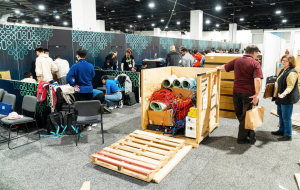
Since 2007, the Student Cluster Competition (SCC) has provided an international multi-day contest for the best and brightest university HPC teams. This year, the in-person event was held at SC23 in Denver from November 13-15, 2023. The competition was chaired by Jenett Tillotson, National Center for Atmospheric Research (NCAR).
The event is a two-day HPC optimization contest where student teams get limited power to run some standard HPC benchmarks. The difficult contest brings together the best and brightest students for a serious competition.
The following eleven teams qualified to compete at SC23 this year.
There was also a group of Indy (independent) teams. The IndySCC is an event sharing the goals of the SCC but with an emphasis on education and inclusion, intended for less-experienced teams. Teams compete remotely using provided hardware through an education-focused experience supported by HPC industry experts during the months leading up to the conference.
Contest Rules
The contest requires each team to solve a series of benchmarks within a power draw limit of 4000 watts. They are allowed an extra 500W for networking gear.
University-based teams choose their hardware (often donated by vendors. However, all hardware must be commercially available and displayed in the 10×10 booth during the competition.
The complete set of rules is available here.
The Benchmarks
High-Performance Linpack (HPL)
The HPL benchmark solves a (random) dense linear system in double-precision arithmetic. It is often used to measure the peak performance of a computer or that of a high-performance computing (HPC) cluster. Their performances with the HPL benchmark determine the ranking of the top 500 supercomputers in the world.
HPC Conjugate Gradient (HPCG)
The HPCG benchmark uses a preconditioned conjugate gradient (PCG) algorithm to measure the performance of HPC platforms with respect to frequently observed but challenging patterns of computing, communication, and memory access. While HPL provides an optimistic performance target for applications, HPCG can be considered as a lower bound on performance. Many of the top 500 supercomputers also provide their HPCG performance as a reference.
MLPerf Inference
Machine learning (ML) is increasingly used in many scientific domains to make groundbreaking innovations. MLPerf Inference is a benchmark for measuring how fast systems can run models in various deployment scenarios. The fundamental motivation behind this benchmark is to measure ML-system performance in an architecture-neutral, representative, and reproducible manner.
SC23 SCC Results
Overall: Swiss National Supercomputing Centre
Linpack: Peking University (181.9 Teraflops)
HPCG: Tsinghua University (2.8 Teraflops)
MLPerf: Peking University and University of California, San Diego
Indy-1st Place: Zhejiang University
Indy-2nd Place: Finnish IT Center for Science
Indy-3rd Place: Universidad Nacional de Córdoba
Congratulations to all the teams. The SCC often provides an excellent “overnight-night” experience for future HPC mavens — well done everyone.
Credit to the Original Article | Explore More of Their Work If You Found This Article Enjoyable.
https://news.google.com/rss/articles/CBMiRmh0dHBzOi8vd3d3LmhwY3dpcmUuY29tLzIwMjMvMTEvMjEvc2MyMy1ocGMtc3R1ZGVudC1jbHVzdGVyLXNtYWNrZG93bi_SAQA?oc=5&hl=en-US&gl=US&ceid=US:en