

Join our community of software engineering leaders and aspirational developers. Always
stay in-the-know by getting the most important news and exclusive content delivered
fresh to your inbox to learn more about at-scale software development.
RESUBSCRIPTION REQUIRED
It seems that you’ve previously unsubscribed from our newsletter
in the past. Click the button below to open the re-subscribe form
in a new tab. When you’re done, simply close that tab and continue
with this form to complete your subscription.
RE-SUBSCRIBE
The New Stack does not sell your information or share it with
unaffiliated third parties. By continuing, you agree to our
Terms of Use and
Privacy Policy.
Welcome and thank you for joining The New Stack community!
Please answer a few simple questions to help us deliver the news and resources you are interested in.
COUNTRY
REQUIRED
Great to meet you!
Tell us a bit about your job so we can cover the topics you find most relevant.
How many employees are in the organization you work with?
REQUIRED
Welcome!
We’re so glad you’re here. You can expect all the best TNS content to arrive
Monday through Friday to keep you on top of the news and at the top of your game.
What’s next?
Check your inbox for a confirmation email where you can adjust your preferences
and even join additional groups.
Follow TNS on your favorite social media networks.
Become a TNS follower on LinkedIn.
Check out the latest featured and trending stories while you wait for your
first TNS newsletter.
As a JavaScript developer, what non-React tools do you use most often?
✓
Angular
0%
✓
Astro
0%
✓
Svelte
0%
✓
Vue.js
0%
✓
Other
0%
✓
I only use React
0%
✓
I don’t use JavaScript
0%
2025-01-17 11:00:36
Docker Replacement Flox Has Libraries for Kubernetes
Flox simplifies Nix for enterprise use, offering a container-free alternative to Docker that promises better dependency management and cross-platform compatibility.
Jan 17th, 2025 11:00am by
B. Cameron Gain

Featured image by B. Cameron Gain.
The startup Flox has demonstrated how its adaptation of Nix can serve as a viable alternative to Docker, making it worth a closer look. While Nix has been around for years and is known for its complexity, Flox has simplified its use and adoption. More recently, Flox has positioned its version of Nix as a potential replacement for Docker containers on Kubernetes.
Flox is described as an environment and platform for both developers and operations teams, offering reproducibility and app deployment in a cross-platform way. However, it achieves consistency across different environments, and can leverage Flox, which incorporates the best features of Nix, making it much more accessible and simplifying the use of Nix environments.
The Nix store operates differently from traditional OCI registries. While OCI registries function effectively, their container layers rely on hierarchical file systems. In such systems, altering one layer invalidates all subsequent layers. The Nix store, by contrast, offers many derivations within the Nix store — with over 120,000 of what Flox calls “Nixpkgs packages.” They may consist of single files or shell scripts, which helps to avoid unnecessary invalidations.
Open source Nix can replace containers and @Docker, and now extends to @kubernetesio says @floxdevelopment‘s Leigh Capili at @rejektsio. @thenewstack pic.twitter.com/cECa6woCrg
— BC Gain (@bcamerongain) November 11, 2024
For instance, when setting up a dependency tree for .sh, only a small number of related files are required. These files can then be reused across various projects, delivering a much finer resolution in dependency management compared to container-based systems.
Cloud Native Nix
As Flox’s Leigh Capili, senior DevRel engineer and Kubernetes contributor, explained during his talk “Cloud Native Nix!” at Cloud Native Rejekts in November, a cloud native individual — someone who already benefits from container images and runtimes — would be interested in packaging software in a way that ensures it only accesses what it needs. Let me contextualize the significance of such an approach.
This environment makes it easy to list what software I’m using from the Nix packages ecosystem. Flox is an open source project we’ve built to make it easier to understand how to use these packages. For example, I can list the software in my home directory, showing the packages I want installed on my system. You’ll see tools like zsh, my favorite text editor, and utilities for terminal tasks.
Typically, software is developed to function, pass tests and be packaged into a container image that can be uploaded to a registry.
However, one compelling reason to rethink packaging arises when using a MacBook, Capili said. MacBooks feature advanced kernels, like the Darwin kernel, which is also used on iPhones. While the Darwin kernel provides impressive isolation features, it cannot currently run OCI containers in the desired way. Although there is an intriguing Darwin containers project that could potentially support this in the future, Capili explained, it is not yet widely adopted.
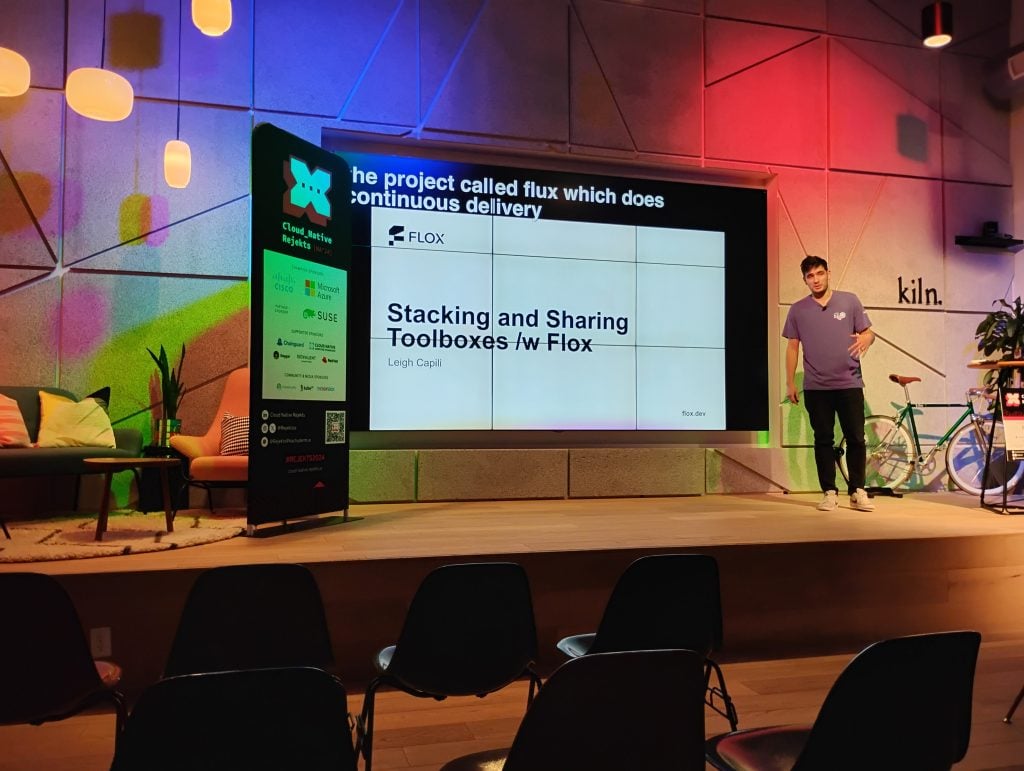
In order to package and use the desired software as cloud native professionals, Capili said users often rely on tools like Docker, Podman or nerdctl to access a daemon running on a Linux environment. Interestingly, the vast majority of software in modern Nixpkgs packages are cross-built on public build farms. These are then stored in a binary cache hosted on a 1.5-petabyte instance. This setup makes the software available natively for macOS, reducing the need to run virtual machines as frequently, which is a significant advantage, Capili said.
During his presentation, Capili explained why a cloud native user, who already benefits from container images and runtimes, would be interested in packaging software in a way that ensures it only accesses what it needs. “The goal is to contextualize the significance of such an approach,” Capili said.
As Capili explained, typically, software is developed to function, to pass tests and to be packaged into a container image that can be uploaded to a registry. With this approach, there seems little reason to reconsider habits, Capili said. Modern tools allow the creation of a working artifact that can be stored indefinitely and deployed on platforms such as Functions as a Service, Kubernetes clusters or even Docker Desktop. This workflow appears sufficient to meet most needs, Capili said.
“Let’s say we want to add more infrastructure-related tools. I could install these packages easily, though I might need to pull a new version,” Capili said. “Ultimately, we want to look at the runtime directory, where my configuration files, binaries and other system components all point to symlinks in my Nix store.”
To fulfill these tasks, there are many different types of software inside the Nix store. Every build happens in a sandboxed environment with network access locked down. The system clock is pinned to ensure outputs are bit-for-bit identical across builds. “This makes it possible to trust that recipes will produce consistent results, enabling us to cache binaries efficiently,” Capili said.
TRENDING STORIES
YOUTUBE.COM/THENEWSTACK
Tech moves fast, don’t miss an episode. Subscribe to our YouTube
channel to stream all our podcasts, interviews, demos, and more.
SUBSCRIBE
Group
Created with Sketch.

BC Gain is founder and principal analyst for ReveCom Media. His obsession with computers began when he hacked a Space Invaders console to play all day for 25 cents at the local video arcade in the early 1980s. He then…
Read more from B. Cameron Gain
TNS owner Insight Partners is an investor in: Docker.
SHARE THIS STORY
TRENDING STORIES
TNS DAILY NEWSLETTER
Receive a free roundup of the most recent TNS articles in your inbox each day.
Credit to the Original Article | Explore More of Their Work If You Found This Article Enjoyable.
https://thenewstack.io/docker-replacement-flox-has-libraries-for-kubernetes/