


And SAT scores are highly correlated with a student’s subsequent grade point average in college. They are an excellent predictor of success, in other words, which is surely what universities should be looking for when choosing students. Recent research in the U.S. has shown that, although high school marks are correlated with success in college, the combination of grades and test results is even better.
The Academic Backlash – and Reverse Discrimination
Still, in an attempt to move even further away from objective measures of capability, some institutions in the U.S. have adopted “holistic” admissions policies, which require students to submit personal essays extolling their admirable qualities, leadership abilities and so on. But in 2021, researchers at Stanford University concluded that personal essays “have a stronger correlation to reported household income than SAT scores.”
As a recent story in New York Magazine put it, “It is easier for a working-class kid to pick up an SAT prep book and study it intensively than it is for them to go on a community-service trip to South America, play travel lacrosse, or flatter the sensibilities of an upper-middle-class admissions official. More critically, it is easier for schools to game intangible criteria in the wealthy’s favor.” And according to research from City Journal, standardized tests predict university academic performance more consistently than interviews or personal essays.

Perhaps the greatest irony of the rejection of standardized tests is the enabling of racial discrimination. Consider how in recent decades, some of the same institutions that once excluded Jewish students have used “holistic” admissions policies to enforce maximum racial quotas for Asian-American students. Asian-American students earn, on average, the highest SAT and ACT scores. If America’s top universities admitted students on the basis of academics alone, many more Asian-American students would be admitted; Harvard University’s own data showed that if it did so the percentage of Asian-American students on campus would nearly double.
Unfortunately for students in this demographic, their race is a problem for many “progressive” university professors and administrators. While the left views some races as “marginalized” or “underrepresented” groups deserving of favourable treatment, it views other races, like Asians, with disdain. In recent years, many have begun calling Asians “white-adjacent” which, to be clear, is meant as an insult. (This insanity has moved to Canada as well. In 2020, a resident adviser at UBC sent out a document to students calling East Asians “oppressor[s]” and citing their supposed “yellow privilege.”)
To limit what it regards as the “over-representation” of Asian-American students, Harvard’s admissions process includes a “personality score.” According to an analysis of more than 160,000 student applications at Harvard, Asian-Americans had higher test scores, better grades and stronger extracurricular resumés than applicants of any other racial group, but had consistently lower personality scores.
How did Harvard judge an applicant’s personality? It claimed to assess unquantifiable metrics like “courage,” “likeability” and being “widely respected” through interviews with students and by reading their application materials. If this sounds subjective and completely arbitrary, it is. As The Atlantic wrote, “While the other categories come with detailed and straightforward criteria, a vague rubric determines applicants’ personality rating; ‘outstanding’ personal skills secure an applicant a top score, for example, and being ‘bland or somewhat negative or immature’ gets her a middling one.” That is to say, there are no real guidelines on scoring a high school student’s supposed personality. Instead, Harvard’s personality score looks much more like the “holistic admissions” criteria it and other Ivy League schools used to keep out Jewish students decades ago.

Harvard and other universities have indeed succeeded in using “holistic” admissions criteria to keep the number of Asian-American students down. As Harvard-educated commentator Ron Unz put it, Ivy League colleges have effectively enforced a hard quota on the number of Asian-American students they will admit. In contrast, the elite California Institute of Technology (Caltech) does not use personality scores or race-based admissions criteria, and Asian-American enrollment has increased in line with expectations, according to their strong academic performance and extra-curricular involvement – and far above their proportion of the population at large.
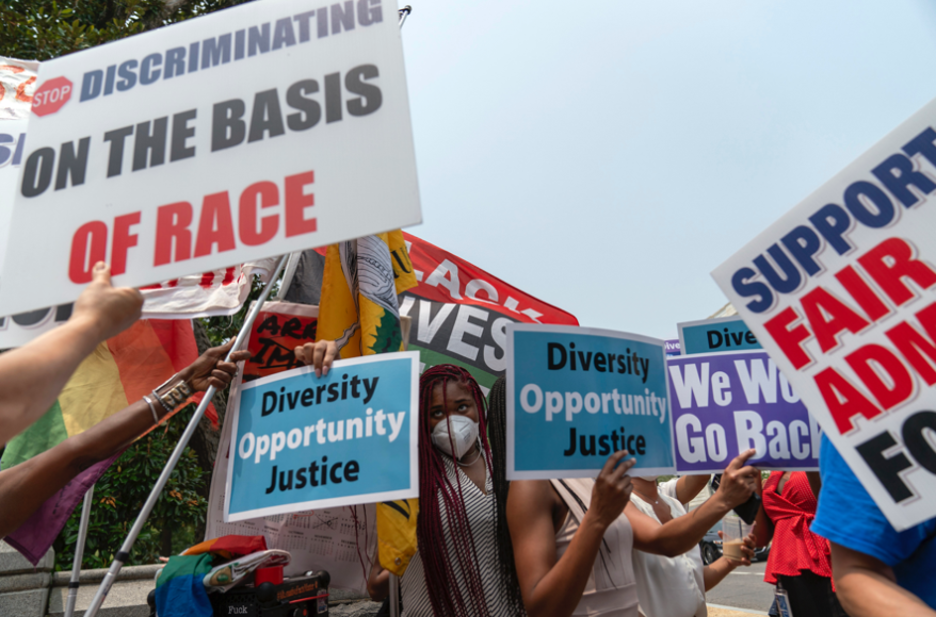
In 2023, the U.S. Supreme Court decisively ordered an end to this invidious form of racism. In its landmark decision Students for Fair Admissions v. Harvard, the Court declared that universities would henceforth be prohibited from discriminating against students on the basis of their race, a great victory for Asian-American students and for equality of all races.
To the ordinary observer, differences in average test scores are simply not evidence of racism. They can be explained by different factors. For example, many studies have long shown that Asian-American students spend much more time studying than non-Asian students. For those who attack standardized tests as tools to benefit the wealthy, the SAT’s own data shows that low-income Asian students on average score higher than wealthy non-Asian students. The difference clearly has to do with individual habits and, probably, cultural values, not racism or classism.
Canada, it should be noted, is not immune to the kind of thinking that drove the Ivy League’s campaign of restriction against Asian-American students. For many years, the Toronto District School Board (TDSB) admitted students to its speciality programs – enriched learning for ambitious students – based, among multiple criteria, on their results on a standardized test. Last year, however, the TDSB’s trustees voted 17-3 to eliminate this test in the name of “equity” and replace it with a lottery system. Students no longer need to demonstrate intellectual aptitude to be admitted to these gifted programs – itself a ridiculous notion. But the TDSB went further and announced that 20 percent of the program’s spots would be held for black, Indigenous, Latin American and Middle Eastern students – excluding Asian-Canadian, Caucasian and South Asian students from those spots no matter how hardworking or intelligent these students are. Quite simply, this is blatant racial discrimination.
Credit to the Original Article | Explore More of Their Work If You Found This Article Enjoyable.
https://news.google.com/rss/articles/CBMiVGh0dHBzOi8vYzJjam91cm5hbC5jYS8yMDIzLzEyL3RoZS1jYXNlLWZvci1hLWNhbmFkaWFuLXN0YW5kYXJkaXplZC1oaWdoLXNjaG9vbC10ZXN0L9IBAA?oc=5&hl=en-US&gl=US&ceid=US:en