

Show us your thinking about a recent Times article, video, graph, photo essay or podcast. Open from Dec. 6, 2023 to Jan. 10, 2024.
Just like we did last year, we’re ending the fall semester with an invitation we hope will be accessible, useful and engaging for students across subject areas: Respond to a Times article, video, podcast, graph or photo essay of your choice by creating an illustrated one-pager.
What is a one-pager? Well, last year’s winning work can show you, but we also like a definition from a National Council of Teachers of English blog post that gives more examples. The writer, Jill Yamasawa Fletcher, describes it as “an image-heavy, idea-driven assessment which prompts students to select the most meaningful ideas in a text, make connections to their own lives, and display the ideas creatively with color, drawings, and quotes.”
She goes on to explain why she experimented with these in lieu of a traditional essay:
The one-pager made the writing component less intimidating, so students were focused more on the ideas in the text. They were not worrying about their transitions or writing a stance or a conclusion. As a result, a lot of anxiety was lifted when we did one-pagers as an assessment.
That is our motivation, too. Most of our contests focus on writing, but we want to honor other kinds of expression — and encourage students all over to find themselves, their communities and their interests in the pages of The New York Times.
Last year’s entries took on topics from comfort food and K-pop to the mating habits of turkeys, dating apps, A.I., the war in Ukraine and climate change. The best of them used writing and illustration to guide us through a complete experience. They summarized key information, surfaced fascinating details, shared personal takes on the topics and fit all those pieces together visually to engage us with their thinking.
We hope your classes will bring the same kind of critical and creative thinking to this challenge, and have just as much fun.
Take a look at the full guidelines and related resources below to see if this is right for your students. We have also posted a step-by-step lesson plan.
Please ask any questions you have in the comments and we’ll answer you there, or write to us at LNFeedback@nytimes.com. And, consider hanging this PDF one-page announcement on your class bulletin board.
Here’s what you need to know:
- The Challenge
- A Few Rules
- Resources for Teachers and Students
- Frequently Asked Questions
- How to Submit
The Challenge
Create a one-page illustrated response to an article, Opinion essay, video, graph, photo collection or podcast from The New York Times that was published in 2023 (or, if you are doing this in January, in 2023 or 2024).
You can make your one-pager by hand or digitally. The goal is to show your engagement with the information and ideas in the Times piece. Be creative and have fun!
Your one-pager MUST include:
-
The headline and publication date of the Times piece
-
At least one quote from the piece (or, if you choose a graph or photo collection, at least one specific detail)
-
At least one image or illustration that in some way sums up, responds to or comments on the piece. You may draw this by hand or find it online, as long as it does not contain any copyrighted material. (That includes images from The New York Times.) You may use Creative Commons images as long as they do not require permission, and as long as you attribute the work to the original creator. You may not use artificial intelligence to generate images.
Your one-pager MIGHT also respond to any of the following. CHOOSE AT LEAST TWO:
-
Why you picked this Times piece
-
Your opinion of it
-
Something you learned
-
A description of how it has impacted your understanding of a topic
-
A summary of the piece in your own words
-
Something you’d like to ask or say to the author(s)
-
Question(s) the piece left you with
-
Connections you made between this piece and something else you have read, heard, seen or learned — in or outside of school
-
Someone you’d like to send this Times piece to and why
-
A word or phrase you learned from the piece and an exploration of its meaning
-
Something this piece showed you about yourself as a reader, viewer, listener or learner
-
A perspective or voice you think the piece was missing
-
Additional information you wish had been included
-
A summary or analysis of the argument and evidence presented in the piece
-
A comparison to how this topic was covered by another media source
-
Something you admired about the Times piece and why
-
Something you think would have made the piece better and why
-
An action you’d like to take as a result of this piece — and why and how
-
Any additional response of your choice. Be creative!
A Few Rules
In addition to the guidelines above, here are a few more details:
-
You must be a student ages 13 to 19 in middle school or high school to participate, and all students must have parent or guardian permission to enter. Please see the F.A.Q. section for additional eligibility details.
-
We’re repeating this one, because it’s important: You may create your one-pager by hand or digitally. If you create it online, be sure not to use any copyrighted material. (That includes images from The New York Times.) You may use Creative Commons images as long as they do not require permission, and as long as you attribute the work to the original creator. You may not use artificial intelligence to generate images.
-
Make sure your one-pager is legible. We will only feature work that is clear enough to read. (Tip: Take a picture of your one-pager from above and export it in the highest resolution your phone allows, and then submit it as a digital image file through the form below.) You can send it to us as a jpeg, png or tif file.
-
The best one-pagers will be detailed, clear, creative and illuminating, and will show us your thinking about, and engagement with, a text.
-
You may work alone or in pairs for this challenge, but students should submit only one entry each.
-
All entries must be submitted by Jan. 10, 2024, at 11:59 p.m. Pacific time using the contest form below.
Resources for Teachers and Students
Use these resources to help you create your one-pager:
-
A step-by-step guide for creating a one-pager, updated for 2023-24
This guide walks you through choosing a piece, reading it carefully and making notes, then designing a one-pager that conveys what you’d most like to say — and uses the work of last year’s winners as mentor texts to help.
-
A collection of free links to over 75 recent Times pieces about young people
A mammoth edition of our Teenagers in The Times collection, featuring photo essays, videos, podcasts and articles about young people and the issues, ideas and trends that interest them.
-
Last year’s winning work for inspiration
-
Our contest rubric
These are the criteria we will use to judge this contest. Keep them handy to make sure your illustrated response meets all of the qualifications before entering.
Frequently Asked Questions
Below are answers to your questions about writing, judging, the rules and teaching with this contest. Please read these thoroughly and, if you still can’t find what you’re looking for, post your query in the comments or write to us at LNFeedback@nytimes.com.
QUESTIONS ABOUT CREATING YOUR ONE-PAGER
What is a one-pager? Is it like a mind map or a sketch note?
They’re very similar. All three combine writing with visual or graphic elements to help learners engage with a text.
For our purposes, the important difference is that mind maps and sketch notes are often used to engage with new material as you are learning it, while one-pagers are used to show your understanding of something after you have learned it. That’s why many teachers invite students to mind map or sketch note as they listen to a lecture, read a book or watch a film, while one-pagers are commonly used as final assessments.
But you are welcome to borrow ideas and strategies from those other forms. For instance, you have probably seen mind maps like these that show a central topic or idea, with branches detailing related information. It’s fine to structure your one-pager like that, as long as you include the details we ask for under “The Challenge,” above.
For more about one-pagers, read this excellent explanation by Betsy Potash in Cult of Pedagogy. We know that research shows that slowing down and deeply engaging with a text helps learners with meaning-making and consolidation of the information. But doing so via both images and text provides additional benefits:
As students create one-pagers, the information they put down becomes more memorable to them as they mix images and information. According to Allan Paivio’s dual coding theory, the brain has two ways of processing: the visual and the verbal. The combination of the two leads to the most powerful results. Students will remember more when they’ve mixed language and imagery.
Where can I see examples?
First, here is the work of our 2023 winners. Take a look at the variety of topics, the range of commentary, and the different types of images, some done by hand, some created digitally. Via our step-by-step guide, you can also see some of that work used as mentor texts for your own.
And here are four more places online to find a variety produced by students all over:
-
NCTE | The Magic of One-Pagers
-
Cult of Pedagogy | A Simple Trick for Success with One-Pagers
-
Spark Creativity | One-Pagers Roundup: Examples to Inspire
-
We Are Teachers | 20 One-Pager Examples, Plus Advice for Using Them With Your Students
Finally, in our step-by-step guide, we have included both some of last year’s winners and a few fun examples made by students in Illinois in 2022. (They had never done one-pagers before, but were willing to help us out by testing this assignment before we made it public.)
But I’m not an artist! Can I still make an effective one-pager?
Of course! Artistic merit is not the focus of this challenge. Stick figures, simple graphics, and the use of color can do all the visual work you’ll need to highlight your thoughts. What we’ll be judging is your engagement with the ideas and information in the text. We encourage you to think deeply about the text. You might read, watch or listen to it several times, discuss it with others, follow links to learn more about the topic, and analyze or draw conclusions about what you’ve read and how it was presented.
Then, choose the best or most interesting of your ideas to put on your one-pager. Show us what happened to you as you made meaning from the text. Maybe you connected it to your own life, or the lives of people you care about. Maybe the piece made you sad, or mad, and you want to analyze why. Or maybe you learned something that challenged your understanding of an issue or concept. Take us on the journey with you.
I don’t know where to begin! What advice do you have?
Please check out our step-by-step guide.
_________
QUESTIONS ABOUT JUDGING
How will my one-pager be judged?
Your work will be read by New York Times journalists as well as by Learning Network staff members and educators from around the United States. We will use this rubric to judge entries.
What’s the prize?
Having your work published on The Learning Network and being eligible to be chosen to have your work published in the print editions of The New York Times.
When will the winners be announced?
About two months after the contest has closed.
_________
QUESTIONS ABOUT THE RULES
Who is eligible to participate in this contest?
This contest is open to students ages 13 to 19 who are in middle school or high school around the world. College students cannot submit an entry. However, high school students (including high school postgraduate students) who are taking one or more college classes can participate. Students attending their first year of a two-year CEGEP in Quebec Province can also participate. In addition, students age 19 or under who have completed high school but are taking a gap year or are otherwise not enrolled in college can participate.
The children and stepchildren of New York Times employees are not eligible to enter this contest. Nor are students who live in the same household as those employees.
Whom can I contact if I have questions about this contest or am having issues submitting my entry?
Leave a comment on this post or write to us at LNFeedback@nytimes.com.
_________
QUESTIONS ABOUT TEACHING WITH THIS CONTEST
Do my students need a New York Times subscription to access these resources?
No. Students can get free access to Times pieces through The Learning Network. All the activities for students on our site, plus the Times articles they link to, are free. So, for example, our new edition of Teenagers in The Times contains over 75 articles they can choose from to do this exercise.
Students can also search topics that interest them using the search tool on our home page. Or, they can scroll through sections like our writing prompts, Film Club, What’s Going On in This Graph?, or even our lesson plans to find linked Times articles that capture their attention.
However, if you are interested in learning more about school subscriptions, visit this page.
I’m not an English or art teacher. Can this work for my students too?
Yes! Teachers across the curriculum already use one-pagers in their classrooms, and this challenge can be customized to fit your subject area.
For instance, teachers in STEM subjects can assign students to choose a piece from the Times Science, Health or Technology sections, and if you scroll through last year’s winners you can see many students chose STEM-related content. For more inspiration, here is how one science teacher uses The Times regularly, and how that practice creates “aha moments” during lab assignments.
History and social studies teachers might invite students to find front page news that connects to something they learned this semester. The Times publishes hundreds of articles from around the globe every day, so you can almost always find something that confronts the very same questions or issues that you’ve been discussing in class. Our lesson plan The Past Is Present: Strategies for Bringing Current Events Into the Social Studies Classroom suggests linking articles and classroom content via essential questions, themes, events, places, people, or historical texts or artifacts.
I’d like to do this to strengthen my students’ media and news literacy. Can this challenge work for that?
Yes! This is one of the chief reasons we’ve added this contest to our roster. We hope that many students will use it to think critically about the news in general and The Times in particular. In addition to the prompts we list above that invite this kind of thinking, teachers and students are always free to invent their own prompts — for the theme of news literacy or for any other theme they’d like to explore. We want this challenge to be as useful as possible.
How do my students prove to me that they entered this contest?
After they press “Submit” on the form below, they will see a “Thank you for your submission.” line appear. They can take a screenshot of this message. Please note: Our system does not currently send confirmation emails.
How to Submit
We will add the submission form here on Dec. 6 when the contest opens.
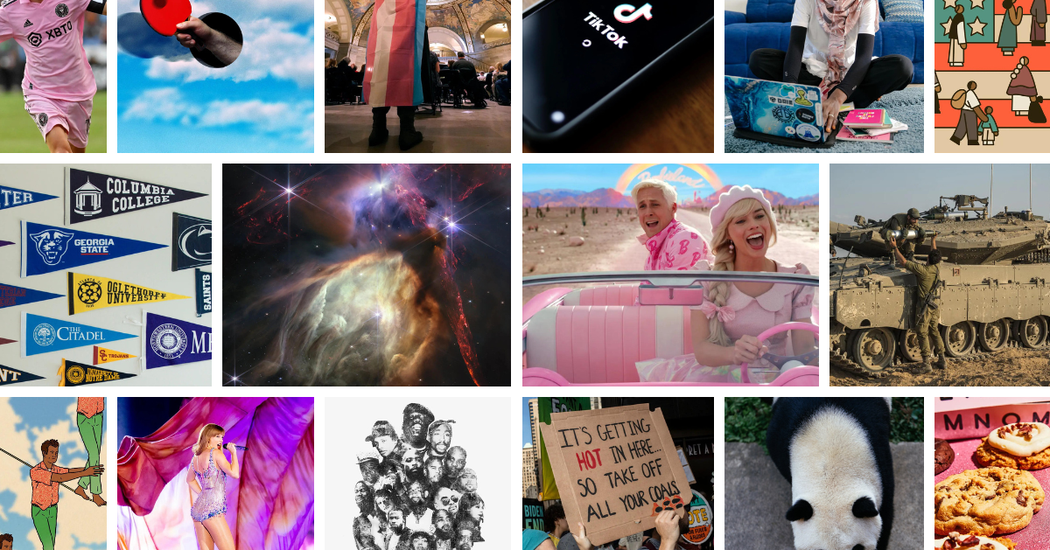
The images at the top of this post all come from Times pieces from this year. Photo credits (from left to right): Top row: Eric Hartline/USA Today Sports, via Reuters Con; Illustration by Nicolás Ortega, photograph by Getty Images; Charlie Riedel/Associated Press; Ritchie B Tongo/EPA, via Shutterstock; Carmen Abd Ali for The New York Times; Rose Wong. Middle row: Kendrick Brinson for The New York Times; NASA, ESA, CSA, STScI, Klaus Pontoppidan (STScI); Warner Bros.; Sergey Ponomarev for The New York Times. Bottom row: Simon Bailly/Sepia; Cassidy Araiza for The New York Times; Illustration by Jon Key; Bryan Anselm for The New York Times; Erin Schaff for The New York Times; Amy Lombard for The New York Times.
Credit to the Original Article | Explore More of Their Work If You Found This Article Enjoyable.
https://news.google.com/rss/articles/CBMibGh0dHBzOi8vd3d3Lm55dGltZXMuY29tLzIwMjMvMTEvMzAvbGVhcm5pbmcvcmVzcG9uZC10by1hLXN0b3J5LWluLXRoZS10aW1lcy12aWEtb3VyLW9uZS1wYWdlci1jaGFsbGVuZ2UuaHRtbNIBAA?oc=5&hl=en-US&gl=US&ceid=US:en


:max_bytes(150000):strip_icc()/GettyImages-1033164992-5f675a3d98c94602a8bfa4ead0bfe2f0.jpg "Writing Problems Common for Students With ADHD - Verywell Mind")