
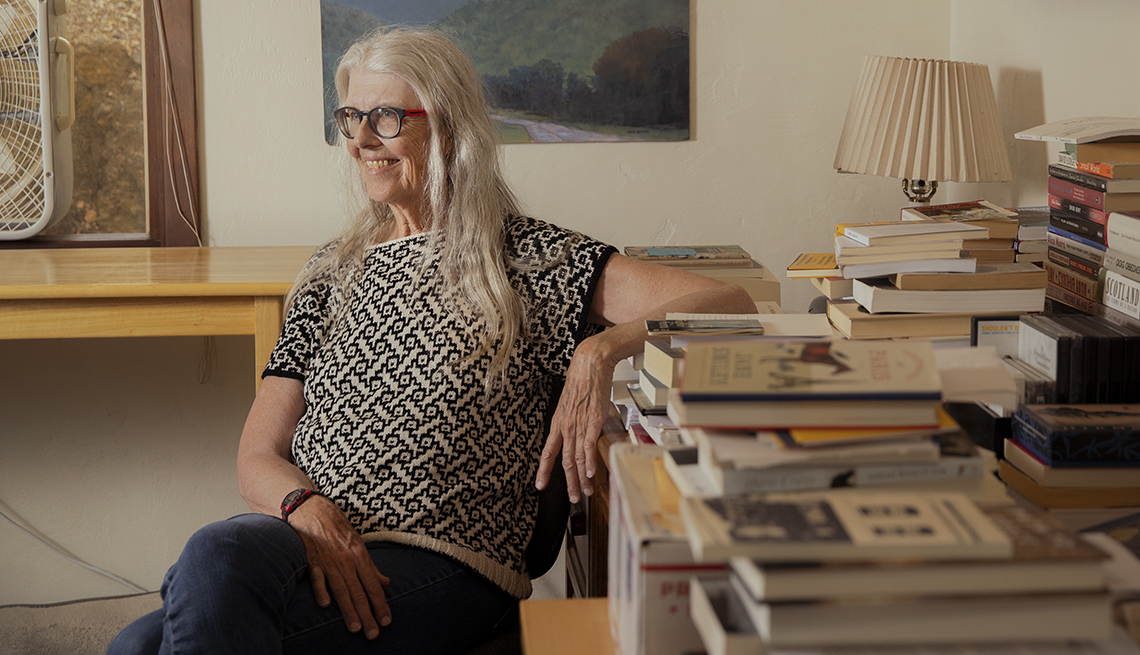

Jane Smiley found literary fame upon the release of her 1991 novel, A Thousand Acres, the best-selling Pulitzer Prize winner set on an Iowa farm and loosely based on Shakespeare’s King Lear. Though that is the book she’s most known for, her substantial oeuvre includes, among many others, a biography of Charles Dickens, a young adult series, and last year’s A Dangerous Business, a murder mystery set in California during the Gold Rush. Her next novel, Lucky, about a folk musician in the era of Joni Mitchell and Joan Baez, comes out in April.
In Smiley’s latest book of essays, The Questions That Matter Most: Reading, Writing, and the Excercise of Freedom (2023), the author discusses her influences (such as Jane Austen and Willa Cather), explains why she thinks Mark Twain’s The Adventures of Huckleberry Finn is overrated, and expounds upon the pleasures of reading beautiful writing. “I love images and sentences that are so striking that you remember and cherish them,” writes Smiley, who grew up in suburban St. Louis and lives in Northern California. We spoke with her recently about her book and the writing life.
In your book, you describe St. Louis as “a perfect spot for a future novelist to grow up.” How so?
There were so many things to look at, so many people to talk to. All different types, sociologically, and all kinds of different cultures. It made me interested in all the people around me.
Are you from a family of storytellers?
Yes, and the stories they told us kids were positive. But then I’d get up and go to the kitchen and someone would say, “Now, that’s not what happened. Here’s what really happened.” That was one of the best things for me. It told me that my mother and my cousins thought differently and had their own points of view.
Your parents separated when you were 1, and you didn’t see your father much. But you write that he gave you two important gifts: your height (6’2″) and his absence.
My father had mental issues, which people didn’t talk about then the way we do now. But, looking back, I think he would have been very domineering. My mom had a busy job [as a newspaper editor], and my grandparents were quite easygoing. So I mostly did what I wanted to do. I wasn’t wild or anything like that. But I had some cousins who were. I didn’t mind observing them being wild.
You’ve written several books about horses. What did riding teach you?
Because horses are herd animals, they pay attention to what other beings around them are noticing. So one of the key aspects of learning to ride is to not be tense. For me, that was hard because I was basically a little scaredy-cat. I’ve never been nervous about writing. It’s physical things that make me nervous.
Credit to the Original Article | Explore More of Their Work If You Found This Article Enjoyable.
https://news.google.com/rss/articles/CBMiTWh0dHBzOi8vd3d3LmFhcnAub3JnL2VudGVydGFpbm1lbnQvYm9va3MvaW5mby0yMDIzL2phbmUtc21pbGV5LWludGVydmlldy5odG1s0gEA?oc=5&hl=en-US&gl=US&ceid=US:en


%20(1000%20x%20600%20mm)%20(4).png "Top 10 EdTech Predictions for 2025 | AI, Cloud Migration, and Teacher Empowerment - EdTech Innovation Hub")