
TOKYO — ‘Tis the season for university entrance examinees in Japan to breathe sighs of relief and check whether they’ve passed. But many are confused after a Tokyo-area university was found to have used at least one of the exact same questions presented in an admission test two years ago.
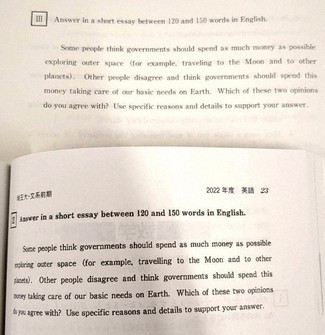
The controversy surrounds an English writing question that appeared in an entrance exam for Saitama University’s faculties of liberal arts, economics and education this February which was pointed out to be identical to a question seen on the test two years ago.
The discovery of the duplicate sparked a range of opinions after making the rounds on X (formerly Twitter), with some calling out the university for its suspected mistake and others emphasizing the value of checking through past-used questions at universities of their choice.
The question asked test-takers to choose whether they support the idea that governments should spend as much as possible on space exploration, or spend this money taking care of basic needs on Earth, and explain why in 120 to 150 words. Everything was identical to the problem on the February 2022 test, a post on X pointed out after the test.
When contacted, Saitama University confirmed the questions were identical, but refused to provide any further info, citing it as a matter related to admissions.
However, there have actually been more than 1,400 such reused questions since the introduction of a system put into place 16 years ago.
Though Saitama University’s intent by reusing the question is unclear, its decision is based on a system in place at other universities as well. In April 2007, a network was established for universities to make use of the good resources they had accumulated. Starting with questions appearing in entrance exams in February and March 2008, four-year public, national and private universities and six-year medical schools have engaged in a system of sharing problems from past entrance exams among each other.
Crafting problems for the entrance exams requires a lot of time and effort, involving hurdles such as content checks of textbooks by different publishers and of standard curriculum guidelines. What can seem like good original questions can wind up as overly difficult or odd questions falling outside the scope of high school education, making their creation a less appealing task.
Additionally, the questions are for the most part single-use. Some universities have reportedly been criticized for using other universities’ past questions, or for unintentionally producing similar questions. The network was created with the goal of resolving all these problems.
As of January 2024, a total of 163 universities including 42 national, 29 public, 91 private and one defense medical college apply the system. Saitama University is among them.
Kochi Univ. top among public institutions
According to Gifu University, which operates the network, questions were reused 204 times in total between 2008 and 2014. For instances from 2015 to 2023, data based on responses from the universities was posted to the network’s website.
A Mainichi Shimbun analysis of the materials from this nine-year period showed that of a total 1,235 instances of question reuse, the contents were changed 90% of the time, but posted as-is 126 times.
Josai International University was at the top with 221 instances, followed by Showa University with 163 and Hiroshima Institute of Technology in third place with 68. Many of the reused questions were of a scientific nature at institutions’ medical faculties.
Among public and national universities, Kochi University was the leader with 49 reuse cases. The university stated that being allowed to use questions from other universities in the medical department, with its numerous questions for science electives and other subjects, has reduced the burden on faculty.
In 260 cases, universities reused their own questions. Seventy-one of these were identical. Tezukayama University in the west Japan city of Nara topped the list in this regard with 44 such questions, followed by Ishinomaki Senshu University with 16 and Yokohama National University with three.
Tezukayama University stated that it distributes questions from the past three to four years at open campus and other events to encourage careful study and accept students with higher motivation.
‘Because the problems are universal’
Hideki Oiwa, a 48-year-old English instructor for major college prep school Toshin, said regarding Saitama University’s reuse of the problem, “I wonder if they reused the question after a brief period of only two years because it’s on a universal topic.” He continued, “Whether one chooses from the persistent questions of the remarkable progress of space development technologies and environmental issues corresponding to our basic needs here on Earth, this was a good question that can’t be answered by rote memory.”
Oiwa also contends that narrower learning strategies based on the thinking that problems will never reappear can be harder to apply, making the improvement of basic English skills more important. Going forward, he predicts “it’s highly possible that more questions will be submitted using the framework.”
* * *
The original Japanese article was written based on information received via “Tsunagaru Mainichi Shimbun,” a submission form for journalism on demand. If there are any subjects you’d like us to cover, please contact us via: https://mainichi.jp/tsunagaru/
(Japanese original by Sahomi Nishimoto, Digital News Group)
Credit to the Original Article | Explore More of Their Work If You Found This Article Enjoyable.
https://news.google.com/rss/articles/CBMiQWh0dHBzOi8vbWFpbmljaGkuanAvZW5nbGlzaC9hcnRpY2xlcy8yMDI0MDQwMy9wMmEvMDBtLzBuYS8wMTkwMDBj0gEA?oc=5&hl=en-US&gl=US&ceid=US:en