
Mirror photo by Patrick Waksmunski /
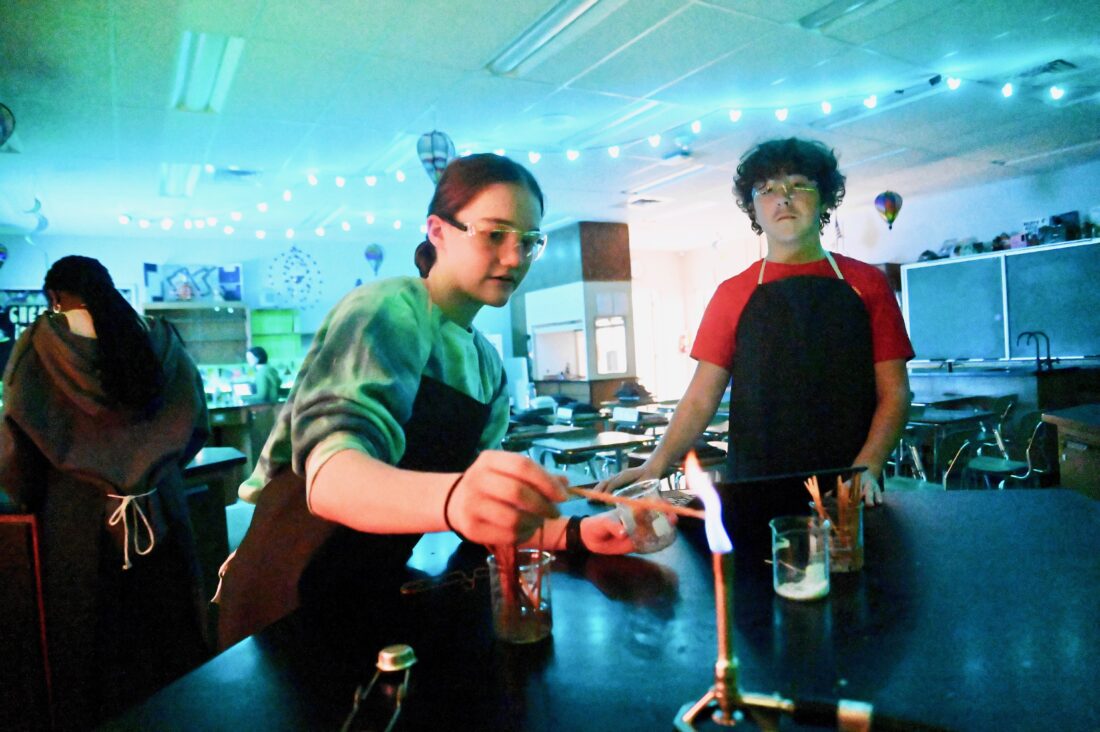
Altoona Area High School sophomore Ekram Saeed conducts a flame test on different elements during her honors chemistry lab on Friday afternoon.
The Williamsburg Community is the only school district in Blair County surpassing the state Department of Education’s projected goal of proficiency in science and biology. According to a recent report assessing districts’ and students’ success for the 2022-23 school year, 91.9% of Williamsburg’s 464 students tested proficient or advanced in science and biology.
The state projected goal, to be achieved by 2033, is 83%, according to the report. Also by 2033, the state wants 71.8% of students to be proficient or advanced in English language arts and 71.8% in math.
The recent assessment results show improvement across all subject areas throughout the state and indicate that some school districts’ scores are returning to pre-pandemic rates.
The statewide average for students who placed proficient or advanced is 54.5% in ELA and literature; 38.3% in mathematics and algebra; and 58.9% in science and biology.
Williamsburg topped those percentages, with 55.3% of students placing proficient or advanced in ELA and 39.8% in math and algebra.
Mirror photo by Patrick Waksmunski /
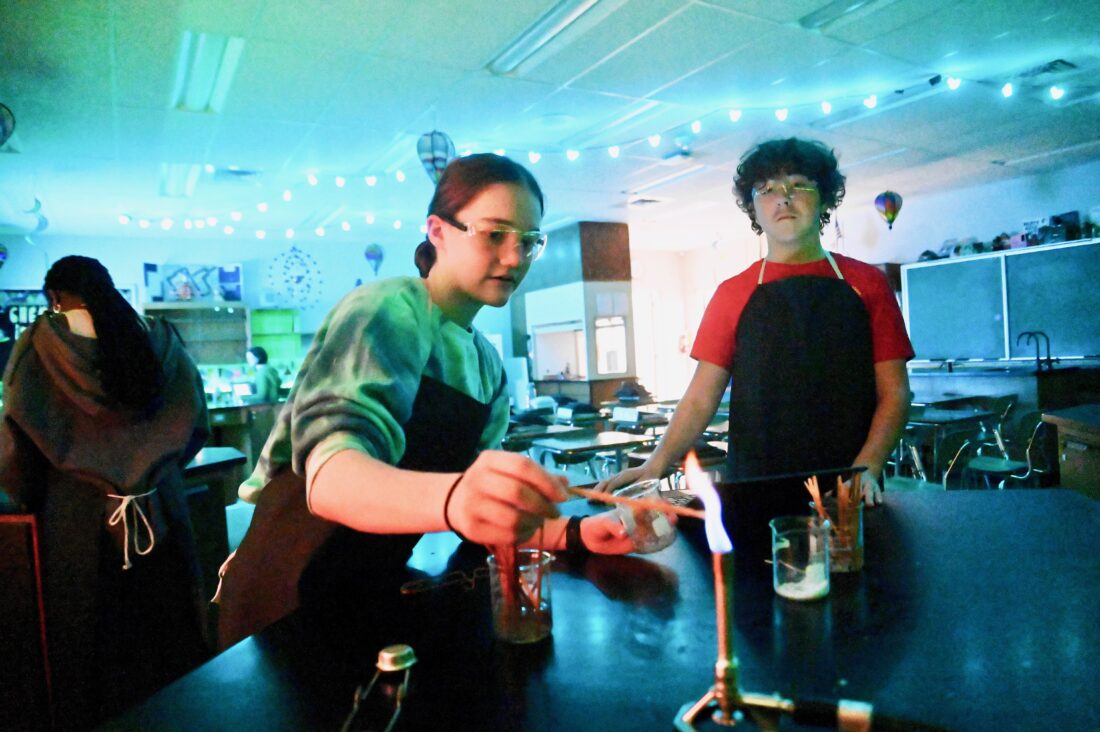
Altoona Area High School sophomores Sage Bower (left) and Keegan Fink conduct flames test on different elements during their honors chemistry lab on Friday afternoon.
Superintendent Lisa Murgas said the district has been working to align curriculum and teacher instruction with student growth.
Murgas said the district made schedule adjustments to include ELA, created math intervention groups at the elementary level and added a half-period in those subjects for seventh and eighth graders.
“The district has added a remediation teacher at the elementary, which has also helped close the achievement gaps due to COVID,” Murgas said, adding the district is also trying to improve its scores in biology and literature.
“We will continue to review curriculum, schedules and student data in these areas and provide professional development as needed,” she said.
Results may be skewed, but still useful
Every school district in Blair County is above the state average in mathematics and algebra across all state assessments — the Pennsylvania System of School Assessment (PSSA), Pennsylvania Alternative System of Assessment (PASA) and Keystone exams — but a few groups fell below the state averages in other areas, the data shows.
In the Altoona Area, 53.1% of students tested proficient or advanced in science and biology, 5.8% below the state average; while in the Spring Cove, 56.8% of students tested proficient or advanced in science and biology, 2.1% below state average; and in the Tyrone Area, 53.4% of students tested proficient or advanced in ELA, 1.1% below the state average.
Those numbers don’t really give an accurate picture, officials said.
There are several factors to take into consideration when looking at the data, both school district and state officials said.
Multiple data points — such as attendance rates and academic growth data — should be considered, along with the fact that Act 136 of 2020 waived “banked scores” for middle and high school students who would have taken a Keystone Exam in the 2019-20 school year, skewing this year’s results from eligible test takers.
Factors such as student population can also distort a district’s image of success for these exams, the report states.
While data limitations prevent cross-year comparisons and comparisons between school districts that tested under different conditions, the department said in a release that the results remain useful for evaluating academic impacts within a given school district.
Altoona Area
In the Altoona Area, 68.2% of students placed proficient or advanced in ELA assessments; 38.3% in math and algebra; and 53.1% in science and biology.
Because many factors and demographics play a role, Superintendent Brad Hatch criticized the state’s projected targets as being too high of a standard to hold students across all districts accountable.
Altoona Area, which has the highest student population of all Blair County districts with 7,226 students enrolled, is below the state’s targeted goal across all academic disciplines — despite performing above state averages.
Hatch said the Pennsylvania Value-Added Assessment System (PVAAS) is a more objective way of measuring success because it measures academic growth — or lack thereof — and compares a student group’s performance on the state assessments to prior years.
According to the PVAAS website, five Blair County school districts were below their growth index in eighth grade PSSA math for 2023.
At a Nov. 13 education committee meeting, Hatch said one possible reason why that is because “these tests are as much reading tests as they are math tests.”
“I can’t believe the state is accepting of an exam where only 20% of the kids across the state are passing the exam,” he said. “I think that speaks volumes to the test itself.”
Hatch said the district targeted “bubble” students who placed below basic or basic in math and has added an intervention of extra instruction into their schedules this year.
He said “bubble” students are those who can improve their scores to proficient by answering a few additional questions correctly.
“We pulled them out (from an elective), and they were given some additional targeted instruction in the areas they were shown historically to be weak in. We did get some pushback from that,” he said.
Haley Fleegle, the district’s assistant superintendent of curriculum, instruction and elementary programs, said that other interventions — such as after school programs and summer programs — were created to help close the gaps in math and ELA.
“We are getting back to almost the way it was before the pandemic,” she said.
Fleegle said being back in the classroom and being able to socialize with their peers is also helping with student learning.
However, Hatch attributed attendance — one of the key factors for success on exams — as an area of concern for the district’s graduation rate. He said the number of students who miss at least 18 days, or 10% of the school year, “is high.”
“Showing up is step one, and in my opinion, it is the most important piece of education,” he said. “If you’re not here, you can’t learn.”
Hatch said the COVID-19 pandemic built an apathy for non-attending individuals.
“Whether it be attending work or attending school, showing up became a real issue,” he said. “We’re still working on recovering from that.”
The district’s focus now, he said, is making sure students feel connected with their school.
“I think we do that by building relationships. They’ve got to know that we care. They have to know that we’re here for you, we’re going to champion for you. So, that’s been a big effort, primarily at the high school but at the junior high as well,” he said.
Bellwood-Antis
Of the 1,166 students enrolled in Bellwood-Antis, 66.9% of students placed proficient or advanced in ELA assessments; 43.1% in math and algebra; and 62.5% in science and biology.
Middle School Principal Don Wagner said the district added extra measures last year to combat a drop in post-pandemic math and ELA test scores in fifth and sixth grades.
He said the drops were a result of the disruptions caused by the pandemic.
“There is a lack of basic skills due to the interruptions caused by the COVID-19 pandemic. We are pretty much playing catch up,” Wagner said.
He said last year’s modifications to the master schedule were made to add more instruction time in math and ELA.
The district is currently utilizing two formats: fifth grade students have a math block from 8:52 to 10:20 a.m. while sixth grade students have two class periods of math.
In both grades, all students have two class periods of ELA.
Wagner said at the end of the year they will evaluate which one works the best.
Claysburg-Kimmel
Of 762 students enrolled in Claysburg-Kimmel, 54.9% of students placed proficient or advanced in ELA assessments; 43.9% in math and algebra; and 67.3% in science and biology.
One of the challenges of being a small school district, Assistant Superintendent Brian Helsel said, is how one or two student scores on state assessments impact overall category scores.
School officials have advanced achievement opportunities throughout the district through researched-based options.
“Approaching these targeted areas through defined, research-based processes is often as important as the instruction. What works for one district does not necessarily mean it will work for another,” he said.
He said the district has increased the use of benchmark assessments to measure how individual students are progressing toward proficiency levels.
“We celebrated our fall benchmark scores at the elementary as they were the highest we have seen. Our teachers and staff have been doing an outstanding job,” he said.
Helsel said state assessments are not a tell-all judgment of whether a student is successful.
“The district acknowledges the role state assessments play,” he said. “However, our teachers, board members, administrators and community members know that there are many other factors to support the cause of developing well-rounded students.”
At Claysburg-Kimmel, Helsel said success is defined as a combination of many factors that exceed any assessment.
“The focus at Claysburg-
Kimmel continues to be maximizing student potential,” he said. “We are a unified group at CK. Everyone who works in the district impacts students in one way or another, no matter the position.”
Hollidaysburg Area
Of the 3,143 students enrolled in Hollidaysburg Area, 61.1% of students placed proficient or advanced in ELA assessments; 50% in math and algebra; and 73.1% in science and biology.
Sarah Palazzi, the district’s curriculum director, said students with individualized education programs and students who are deemed economically disadvantaged by the state in particular are struggling with math and science.
In addition, she said many study skills students typically learn in class were lost during the COVID-19 pandemic.
The district is taking multiple measures to help its students succeed, according to Palazzi, who said it’s important to “meet students where they are” and focus on students’ mental wellness.
“Teachers spend an enormous amount of time planning lessons, activities and assessments that meet students where they are so they can be successful,” she said, adding teachers modify assignments and classroom activities to ensure students are learning.
According to Palazzi, enhanced core reading instruction and a spring math intervention were added in the kindergarten through second grades to improve literacy outcomes and basic math fluency.
She said the district realigned curriculum in the junior and senior high schools, with high school students learning biology over the course of two years.
Last year, members of the district and community leaders came together to develop a “Portrait of a Golden Tiger,” which Palazzi said is the district’s vision of six essential characteristics that determine success.
She said the characteristics are: citizenship, adaptability, analytical thinking, integrity, perseverance and communication.
“We explicitly teach and model these competencies to all students, K-12,” she said. “When students exhibit those competencies — plus kindness, willingness to try and ownership of their learning — our students have succeeded.”
Spring Cove
Of Spring Cove’s 1,658 students, 59.3% of students placed proficient or advanced in ELA assessments; 40.3% in math and algebra; and 56.8% in science and biology.
Superintendent Betsy Baker said the district prides itself on “building a foundation of excellence one student at a time.”
She said student success can be measured against many factors that are not measured by the state exams.
“We have students who are phenomenal artists and musicians, but those talents and skills are not measured on the PSSA or Keystone exam,” she said, adding teachers strive to prepare students for exams as best they can.
“I’m not aware of any employer using PSSA or Keystone exam scores as hiring criteria,” Baker said. “Overwhelmingly, though, employers want employees who come to work and hold the applicable credentials.”
According to Baker, the district’s attendance and graduation rates are consistently above statewide average. More than half of students graduate with industry-based learning experiences or credentials, she said.
To combat an initial drop in scores after the pandemic, the district used federal COVID funds to purchase new curricular materials for math and reading, which helped the district improve and stabilize, Baker said.
At the elementary level, she said their faculty includes reading and math intervention specialists, who each provides direct support for students, as needed.
At the middle school level, time for intervention and enrichment in math and ELA were embedded into the schedule to allow teachers opportunities to reteach and reinforce skills and also to pre-test and pre-teach, and advanced learning for high performing students.
Tyrone Area
Of Tyrone Area’s 1,759 students, 53.4% of students placed proficient or advanced in ELA assessments; 45.7% in math and algebra; and 78.1% in science and biology.
Middle School Principal Shane Cowher said the district’s teachers focus on the individual growth of their students as “test scores can be the result of many different factors.”
“Over the past few years, we have implemented several new curricular resources,” he said, adding both the elementary and middle schools have implemented an intervention period during the day to strengthen targeted growth areas for students.
He said students in kindergarten through eighth grade currently use a SAVVAS learning program to improve ELA scores.
Responding well to open-ended questions has been a consistent focal point for the students, he said.
“This is an area where it is very important for students to explain themselves so they can get all the points for each question,” Cowher said.
In addition, the district implemented “a fundamental math program” called spring math for its students to further strengthen growth in mathematics.
“It is important for us to see continual growth in students,” he said. “So much more goes into schooling than one test.”
Cowher said classroom grades, graduation rates, attendance rates and college and career readiness are a way to measure a student’s success. Participation in club, extra-curricular activities and engagement in the school and community are important, too, he said.
“These other measures paint a much broader picture of education than test scores alone,” Cowher said. “We take these tests seriously, but we understand these are only one measure of success. We just ask students to work hard each day and try their best on the exams.”
Mirror Staff Writer Matt Churella is at 814-946-7520.
Today’s breaking news and more in your inbox
Credit to the Original Article | Explore More of Their Work If You Found This Article Enjoyable.
https://news.google.com/rss/articles/CBMihgFodHRwczovL3d3dy5hbHRvb25hbWlycm9yLmNvbS9uZXdzL2xvY2FsLW5ld3MvMjAyMy8xMi9mb2N1cy1vbi10aGUtZnV0dXJlLWxvY2FsLWRpc3RyaWN0cy10YWtlLXN0ZXBzLXRvLWltcHJvdmUtc2NvcmVzLWFmdGVyLXBhbmRlbWljL9IBAA?oc=5&hl=en-US&gl=US&ceid=US:en