

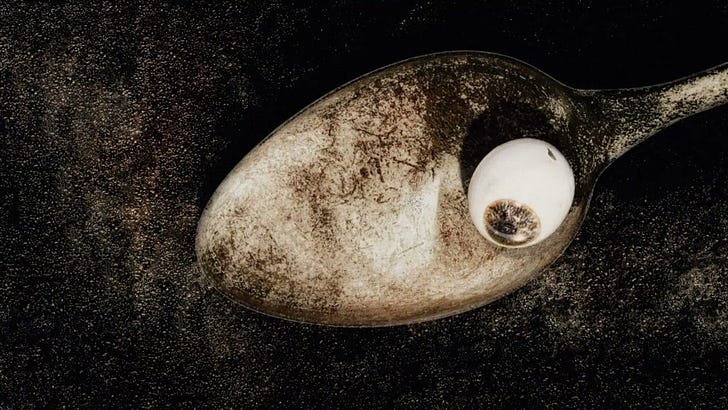
RIP David Lynch, 1946-2025
I’m absolutely devastated by the breaking news of filmmaker David Lynch’s death. He’s been one of the great influences on my writing and is simply one of my favorite artists in any medium ever. The title of my third short story collection, Now It’s Dark, the line repeated throughout the film Blue Velvet by the monstrous Frank Booth, is a nod to that inspiration. In honor of the life and work of one of the greatest artists of our time, I’m reprinting my column from Black Static where I wrote about “The Return” partway through its run on Showtime in 2017.
What I didn’t include in the column but said later to several people was that I felt genuinely privileged to watch “The Return” unfold as it was broadcast, that I had the awestruck sense of being in the presence of a truly towering genius—the kind you only get a few of each century—unspooling one of his finest works. What a phenomenal body of work he leaves behind, films I will never stop watching and learning more from in every viewing. What a loss. What a bad day this is.
You might also enjoy this strange and wonderful and Lynchian article by Kier-La Janisse, “In Heaven Everything is Fine: Murder and Martyrdom in the Lynchverse, from Peter Ivers to Laura Palmer,” on the murder of Peter Ivers, who co-wrote the song “In Heaven Everything is Fine” from Lynch’s 1977 feature Eraserhead, and all the weird synchronicities surrounding his life and death.
Letter From Somewhere is a reader-supported publication. To receive new posts and support my work, consider becoming a free or paid subscriber.
Unless you’ve been stranded somewhere extremely remote with no access to media outside of Black Static for the past couple of years, you’re probably aware that David Lynch has returned to the small screen with a new season of Twin Peaks. I haven’t really read any commentary on the new episodes so far or paid much attention to their reception because, well, I don’t actually really care. I’m enjoying this deep dive into the psyche of Lynch (and Mark Frost, lest we forget!) away from the low constant buzz of social media or critical nattering.
This journey back to Lynchland has been, for me, a revelation. The twenty-first century has been hard on Lynch fans longing for his feature-length storytelling; we’ve had only Mulholland Drive and Inland Empire, and nothing at all for a decade. Lynch has been a huge influence on me since the early nineties, but in this long stretch with no new work, my understanding of that influence had waned. Everything I loved by him was still powerful when I went back to it—and indeed, rewatching season one of Twin Peaks last year, I was stunned anew by what he had managed to accomplish on American network television in 1990—but there’s no substitute for watching new material from him in 2017.
I had honestly not imagined that I could be so inspired in this particular way by a writer or filmmaker at this point in my life. Just as there is nothing quite like the all-encompassing imaginative experience of reading as a child, there is an exhilarating experience, as an adolescent and young adult, of finding art that breaks rules. As a teenager, long before I knew words and concepts like metafiction, I was entranced when a friend pressed a copy of Slaughterhouse Five into my hands, saying something to the effect of it being weird and unlike anything he’d ever read before and that I should read it1. He was right. It sounds so ordinary—Vonnegut, right?—but the gateway writers through which many of us first encounter ideas such as the breakdown of narrative and linguistic games often do seem mainstream or obvious to adult readers. It’s important to remember that when you are young, everything is fresh, everything is new. I remember reading Slaughterhouse Five with such a sense of giddy delight because I hadn’t know you were allowed to do things like that in fiction.
Lynch, of course, goes well beyond metafictional experiments, with a set of personal obsessions, subtext and a worldview so unique that only the eponymous adjective Lynchian can begin to encompass it. Fresh Lynch, in the form of Twin Peaks: The Return is a reminder that there are still artists who can intoxicate me. Working with Frost, what Lynch is putting onscreen is uncompromising, fiercely personal, challenging. Online, I saw someone fret that with 18 episodes, perhaps Lynch had been given space to be overly indulgent. I thought: Indulgent? If you’re worried about the man being indulgent, why on earth are you watching Lynch in the first place?
#
Years ago, someone whose writing advice I trusted said that while it was okay to write ambiguous stories, the writer had to have a very clear understanding of what was going on in those stories. The trouble with writing advice, no matter who it’s coming from, is that when it’s prescriptive in this way, all it really means is this is a thing that has been true for me. And this turned out to be very bad advice for me.
The problem with this advice is that it removes the role of the subconscious or unconscious mind from the creative process. There’s a kernel of truth in it; when you write a story that is allusive, ambiguous, enigmatic, it has to feel true. There’s a difference in aiming to convey something but failing and simply fucking with the audience. That’s the advice I needed. Is it real? Is it true? Is it sincere? I eventually figured that out on my own, but watching Twin Peaks: The Return is reminding me to be even bolder.
And while Lynch can be playful, he is also absolutely sincere, sometimes painfully so. Watching Lynch with an audience is always an interesting experience because most of the time, he refuses to give you conventional cues as to how you should react to something. And then you realize how dependent you are on those cues. Am I supposed to be laughing? Crying? Moved? Afraid? He is a master of making his audience as uncomfortable as possible in a variety of way, and people don’t know what to do with themselves during scenes like Jeffrey’s outburst to Sandy in Blue Velvet: “Why are there people like Frank in the world? Why is there so much trouble in the world?” We laugh nervously because of the bald earnestness and naivete of the question, but the truth is we have all asked ourselves the same thing. And then Sandy relates her dream of robins, coming to a dark world where there was no love. “There will be trouble till the robins come,” she says. I think this scene gets at one of Lynch’s core truths that we see reimagined over and over in his work: there are two worlds existing side by side, one of love and light, and one of unimaginable horror.
#
David Lynch is, among other things, a horror director. He said as much himself, in his audacious billing of Lost Highway as “a 21st century horror noir,” but plenty of us had already long considered his work firmly rooted in the horror aesthetic. Moreover, he’s one of the few filmmakers who makes movies that genuinely terrify me.
Of course, he is many other things as well: his work, is, by turns or sometimes all at the same time, melodramatic, surreal, noirish, saccharine, explicitly and sickeningly violent, idealistic. But above all, what I am finding so wildly inspiring about Twin Peaks: The Return is its absolute boldness. This is Lynch firing on all cylinders, uncompromising, relentless, and maddening. Engaging in a critical manner with books and films is usually one of the pleasures of the mediums for me, yet I find myself reluctant to critique or analyze anything that is happening in the new series. It’s partly because this is clearly an 18-hour movie we’re watching and to do so feels premature, but it’s also because I’m not sure how much value there is in making glib observations the morning after. Lynch’s work simply does not lend itself to easy or quick assessment, and to do so feels like an attempt to make something small and manageable and digestible out of storytelling that is anything but that.
In order to produce work that is truly great, we have to be unafraid. We have to take enormous risks, expose ourselves to the possibility of ridicule and failure. This is almost entirely antithetical to the aims of commercial publishing and filmmaking, which above all wants sure things and even-more-successful versions of what has come before. Lynch’s career, of course, has suffered terribly from his inability to color in those commercial lines. In addition to his struggles to get funding, he’s often critically misunderstood and reviled as well, with an understanding and reassessment of some of his films only coming years after their initial release. Against this backdrop, it seems almost impossible that, at the age of 71, he’s been given the opportunity to return to one of his most beloved works and finish what he was forced to cut short 26 years ago. The sad truth is that in an artist’s own lifetime, being an uncompromising visionary doesn’t usually end well. And yet, I’m never sure it’s worthwhile making art in any other way—and the audacity and brilliance of Twin Peaks: The Return only serves to further that conviction.
1
His exact words as I remember them specifically were “Read this, it will change your life.” And it did!
Credit to the Original Article | Explore More of Their Work If You Found This Article Enjoyable.
https://letterfromsomewhere.substack.com/p/a-place-both-wonderful-and-strange