


When I was 25, I took a job at a bakery in a small college town in the Midwest. I worked front and back of house, pulling espresso shots at the bar and running into the kitchen to grab my (often burned) sugar cookies from the oven.
My boss and I had agreed on a weekly schedule — I wanted desperately to be a writer and was trying to carve out time to work on my novel — but it seemed like she was always asking me to take on another shift, or stay late, or come in early, and I found it difficult to refuse. If I said no, I worried that I would be leaving her in a jam, or that she might decide I wasn’t worth keeping on the staff at all. (My skills in the kitchen hardly justified my presence.)
One afternoon I was venting about it to my stepfather, expecting his sympathy, and he just shook his head, vaguely amused. Then he offered one of the best pieces of wisdom I’ve ever received: “She has the right to ask the question, and you have the right to say no.”
This was mind-boggling in both its simplicity and its radical reframing. The requests that I’d experienced as acts of violation were really nothing of the sort; it was not only my right but also my responsibility to draw my own boundaries, rather than expect another person to draw them for me.
In my early 20s, I’d struggled to cancel a gym membership — wondering whether the young “membership manager” was going to be yelled at by her boss if she didn’t meet her quota, because of me. And I’d always struggled to say no to a drink (or a joint, or a line), which wasn’t just about wanting to get drunk or stay that way (though yes, sure, of course) — it also had to do with imagining the twinge of embarrassment or rejection the other person might feel if I declined.
What was so hard about saying no? Often it was the fear of disappointing someone, not being able or willing to meet some need. But it was also often the fear of permanently losing something — a chance, an opportunity, a connection. Every offer was a message that would self-destruct 10 seconds after I refused it, never to be seen again.
Almost every woman I knew had expressed, at some point, difficulty saying no. I felt a sense of identification at once rabid and tender, but I was also a little suspicious of all of us: Had this become a kind of collective humble brag? Were we all sending signals about how much the world wanted from us, how generous and giving we all were? It almost felt unseemly — selfish, even — to not struggle with saying no.
But it wasn’t only generosity that drove me. The inability to say no was tangled with other things: a mercantilist desire to shore up affection, gratitude and opportunities, and a craven, self-centered fear that I would be annihilated by someone else’s hurt or disapproval.
Shortly before I published my first collection of essays in 2014, when one of my writing instructors recommended me for a teaching position, I was so flattered that I didn’t even think about whether I wanted it. And when I got it, I was terrified to turn it down, afraid that not only would “they” be angry with me, but also that the universe would punish me for my lack of appreciation.
My teacher, who had helped me get the opportunity in the first place, was also the one who helped me understand why it was OK to refuse it: Other opportunities would come in its wake.
When I finally turned down the teaching position, it felt like a knot had loosened inside of me. But it didn’t make it any easier the next time. As my career progressed, I started receiving more opportunities — more invitations to come speak, come teach, come read, come write a piece — and it still felt as if it were a sign of ingratitude not to take all of them.
Eventually, I ended up utterly exhausted. I collapsed in the middle of a movie theater and took an ambulance to the emergency room. It turned out that I had a burst ovarian cyst and a long-term infection that hadn’t been diagnosed. It felt like my body telling me: Stop.
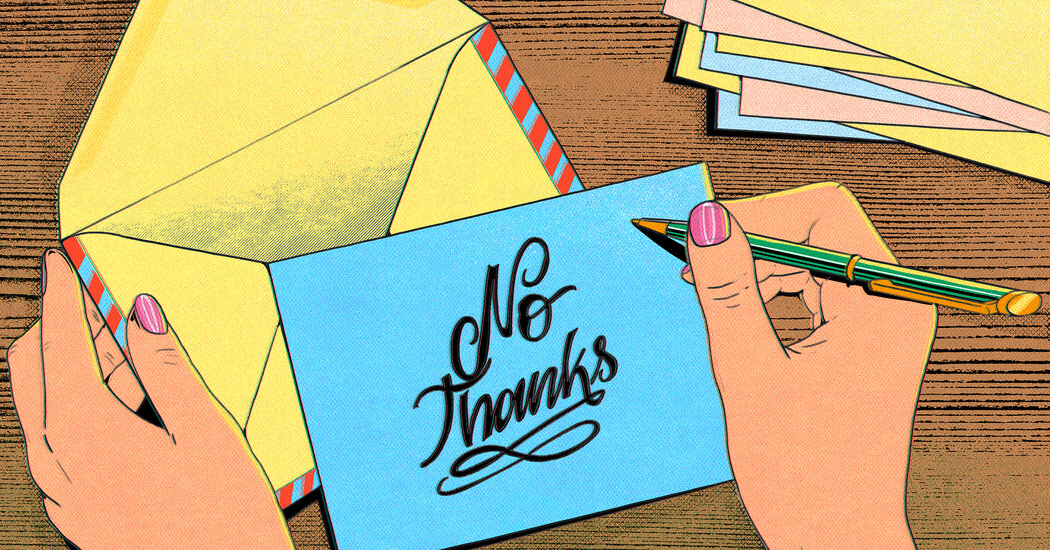
After coming home from the hospital, in the quiet of my apartment, I decided to make something I called the “Notebook of Noes.” On every page, I wrote down an opportunity I had decided to decline: a speaking gig, a magazine commission, an invitation from a friend. Then I drew a line across the page. Underneath, I wrote what saying no had made room for: more time with my partner. More time at home. More time to write. More time to call my mother and ask about her day, and tell her about mine.
Because I was a writer, it helped me to list my own refusals in a notebook. It was as if, in their accumulation, they could create a meaningful text: the story of learning to live a different way.
As I gathered more of these noes, I learned that, even after I’d uttered the word, the world continued just as it always had. The people I’d been anxious about disappointing? They were OK. The fear of losing something for good? It often came back, or something else did.
More than anything, however, the Notebook of Noes helped me see absence as a form of presence — instead of lamenting the ghost limb of what I wasn’t doing, I could acknowledge that every refusal was making it more possible to do something else.
In the past 10 years, I’ve practiced saying no in every arena of my life: saying no to men I didn’t want to go on second dates with. Gently interrupting students who were talking too much in class. Turning down speaking gigs because I didn’t want to be away from home.
In each case, I remind myself what the “no” is carving space for: a better date, for myself and for the man who asked. More room for other students to participate in the class conversation. More time with my daughter. Always, as they say in recovery, a question of progress not perfection.
The flip side of saying no is saying yes more fully, less grudgingly — because I’m not living life like a pat of butter spread too thinly across toast.
I still think about my stepfather’s advice; although he is no longer alive, it makes me feel close to him. And, recently, my daughter asked me to take her to an indoor water park that we love, in a massive mall in New Jersey. Even though I felt overwhelmed by my to-do list, I said yes: to water slides and French fries and the swells of a wave pool under a huge glass roof. The space we shared was built of noes; it was worth every one of them.
Credit to the Original Article | Explore More of Their Work If You Found This Article Enjoyable.
https://news.google.com/rss/articles/CBMiO2h0dHBzOi8vd3d3Lm55dGltZXMuY29tLzIwMjQvMDIvMjgvd2VsbC9taW5kL3NheWluZy1uby5odG1s0gEA?oc=5&hl=en-US&gl=US&ceid=US:en