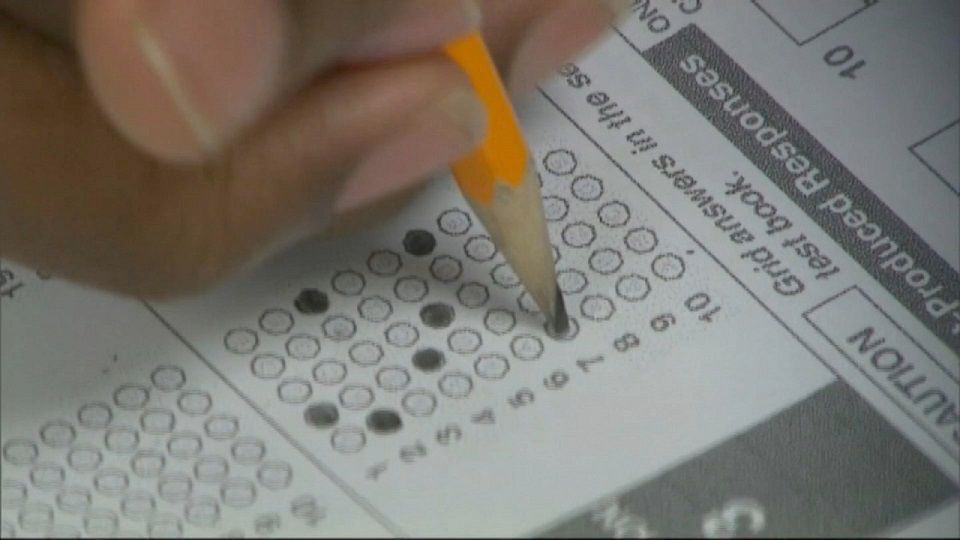



STAMFORD — Early assessments of Stamford students in elementary and middle school grades this year show a kindergarten class that is mostly below literacy benchmarks and a middle school population displaying little year-over-year improvement.
Those were some of the key findings from a presentation given by Chief Academic Officer Amy Beldotti to the Board of Education’s Teaching, Learning & Community Committee.
The numbers were taken from beginning-of-year assessments, which give teachers and administrators a baseline to identify how each student can improve as the school year progresses. Scores are assessed against end-of-year standards, which partially explains why so many students fall below those standards at the beginning of the school year.
“It really helps us identify where students are against grade level standards,” Beldotti said Tuesday.
The data showed that about 47 percent of kindergarten students in Stamford this year scored well below grade level in their first literacy assessment. Another 19 percent, roughly, scored below the benchmark, while 34 percent met or exceeded expectations.
Beldotti noted that as students make their way through Stamford elementary schools, their performance tends to improve. For example, about 57 percent of third grade students this year started the school year off at or above the literacy benchmark, while about 27 percent were well below.
The academic officer said the district decided to examine the kindergarten population this year to identify why so many students test poorly when they enter Stamford schools. The data showed that three out of every 10 students who started kindergarten in Stamford this year had no preschool experience, and most of that population was made up of Hispanic students.
“This number is larger now than it was pre-COVID,” Beldotti said.
Additionally, students with preschool experience preformed much better than those with no prior education before kindergarten.
About 41 percent of kindergarten students who attended preschool scored at or above the literacy benchmark, while only 20 percent of students with no preschool experience scored the same.
“This is a community issue that I think deserves more attention and I think it’s also something to be thinking about with (the) new cutoff age for kindergarten,” Beldotti said, referring to a new state law that requires kindergarten students to be 5 years old before Sept. 1 to enroll in school that year.
Beldotti also presented a slide that showed that third grade students who have been in Stamford Public Schools since kindergarten dramatically outperformed students who have not been in the district as long.
“What’s nice about this is you can see that the longer kids are with us … there is measurable growth and we are seeing many more students in third grade starting off the year at or above grade level,” Beldotti said.
Black and Hispanic students continue to lag far behind their white and Asian counterparts, according to the data.
The percentage of Black students in grades K-3 who scored below or well below the benchmark in literacy was about 59 percent. About 66 percent of Hispanic students in the same grade levels started the year below or well below grade level, though that percentage shrinks to 58 percent when looking at non-English learner Hispanic students.
English learner students are typically new arrivals who have a limited understanding of the English language.
In comparison, about 27 percent of Asian students and 40 percent of white students scored below the benchmark in literacy in grades K-3.
The district uses the assessment DIBELS — dynamic indicators of basic early literacy skills — to identify the reading level of students in grades K-3. Starting this year, the district began using the assessment iReady for literacy in grades 4-8 and for math in grades 1-8.
Both assessment are given three times a year to gauge student growth.
The DIBELS test does not provide any modifications for English learners or special education students.
Also during the presentation, Beldotti shared literacy scores for grades 4-8, which showed how the percentage of students who scored on or above grade level grew, as did the percentage of students categorized as “three or more grade levels below” benchmark. One-fourth of fourth grade students scored in that category and a whopping 42 percent of eighth grade students scored the same.
That trend was also present for math scores across elementary and middle school grades.
Board member Andy George was concerned that literacy data showed a larger percentage of students who are many grade levels behind the benchmark in fifth grade compared with fourth grade.
“Fifth grade is obviously a crucial year,” Beldotti said. “Those students are headed off to middle school and we want to make sure that principals are aware of this and putting resources into the right grade levels — into the right students — before they head off into middle school.”
George also noted how the percentage of students behind in math and literacy in the middle school grades got bigger with each grade level.
“It was almost alarming how the grade level below just seems to be ballooning from sixth to eighth grade,” George said.
He said the transition from eighth to ninth grade is a crucial one for students.
“That first year is incredibly important and are these students going to be disadvantaged in a way because they’re not performing?” he asked.
Credit to the Original Article | Explore More of Their Work If You Found This Article Enjoyable.
https://news.google.com/rss/articles/CBMia2h0dHBzOi8vd3d3LnN0YW1mb3JkYWR2b2NhdGUuY29tL2xvY2FsL2FydGljbGUvc3RhbWZvcmQta2luZGVyZ2FydG5lcnMtYXNzZXNzbWVudHMtdGVzdC1zY29yZXMtMTg0OTQxMzEucGhw0gEA?oc=5&hl=en-US&gl=US&ceid=US:en